

Closed bypass is a bypass operation done without dividing the breastbone. That is why patients call it “closed.” The medical name is minimally invasive coronary bypass. It is not a stent, and it is not an angiogram. We connect one of your own vessels beyond the blockage. We do it without opening the chest from top to bottom.
In clinic the question usually arrives like this: “If it can be done through a small incision, why doesn’t everyone have a closed bypass?” Because a small incision does not fit every chest or every pattern of disease. In the right patient, leaving the breastbone intact changes pain, wound worry, and the return to daily life. This article answers the questions I am actually asked, in that order.
Note: This article is general information. It does not replace a consultation, a diagnosis, or a treatment decision. If you have sudden chest pain, breathlessness, or a feeling that you may faint, seek emergency care without delay.
People use the word “closed” for three different things
The same word comes up in clinic for three separate procedures. Before any decision, we need to know which one we are talking about.
- A stent. A small metal scaffold is placed inside the narrowed artery from the wrist or groin. It is not an operation, and the chest is not opened. Some patients call this a “closed” treatment too.
- Open bypass on a beating heart. The breastbone is still divided. The difference is that the heart is not stopped, and the heart-lung machine is often not used. The incision is not smaller.
- Minimally invasive, truly closed bypass. The breastbone is not cut. We enter between the ribs, from the side of the left chest.
This article is about the third. I have written separately about the choice between a stent and bypass.
Why would I have a closed bypass?
People ask this as if the answer were “because it is newer.” Newness is not my reason. In the right patient, these are the differences I actually see.
You do not wait for the breastbone to knit. In open surgery the breastbone is divided and wired back together. Until it heals, often six to eight weeks, lifting a child, carrying weight, and turning a steering wheel hard are uncomfortable. Closed bypass has no bone incision. Most of that restriction goes away.
Pain comes from the incision, not from the bone. There is no painless heart operation. After closed bypass the pain sits at the incision on the left chest. You feel it when you cough and when you take a deep breath. We do not expect the weeks of bone pain that follow splitting the sternum. With pain relief and breathing exercises, most patients tolerate this within a few days.
The wound is smaller, and worry about a bone infection falls. Infection of the breastbone is uncommon, but it is serious. Diabetes, excess weight, and long-term steroid use raise that risk. If the bone is never opened, the risk drops sharply. A small wound is also simpler to care for.
Daily life returns sooner. Desk work, walking around the house, and self-care are possible earlier for many patients than after open surgery. We do not rush heavy physical work or sport. I give a date according to your job and how you are healing. I have also described the broader course in recovery after bypass surgery.
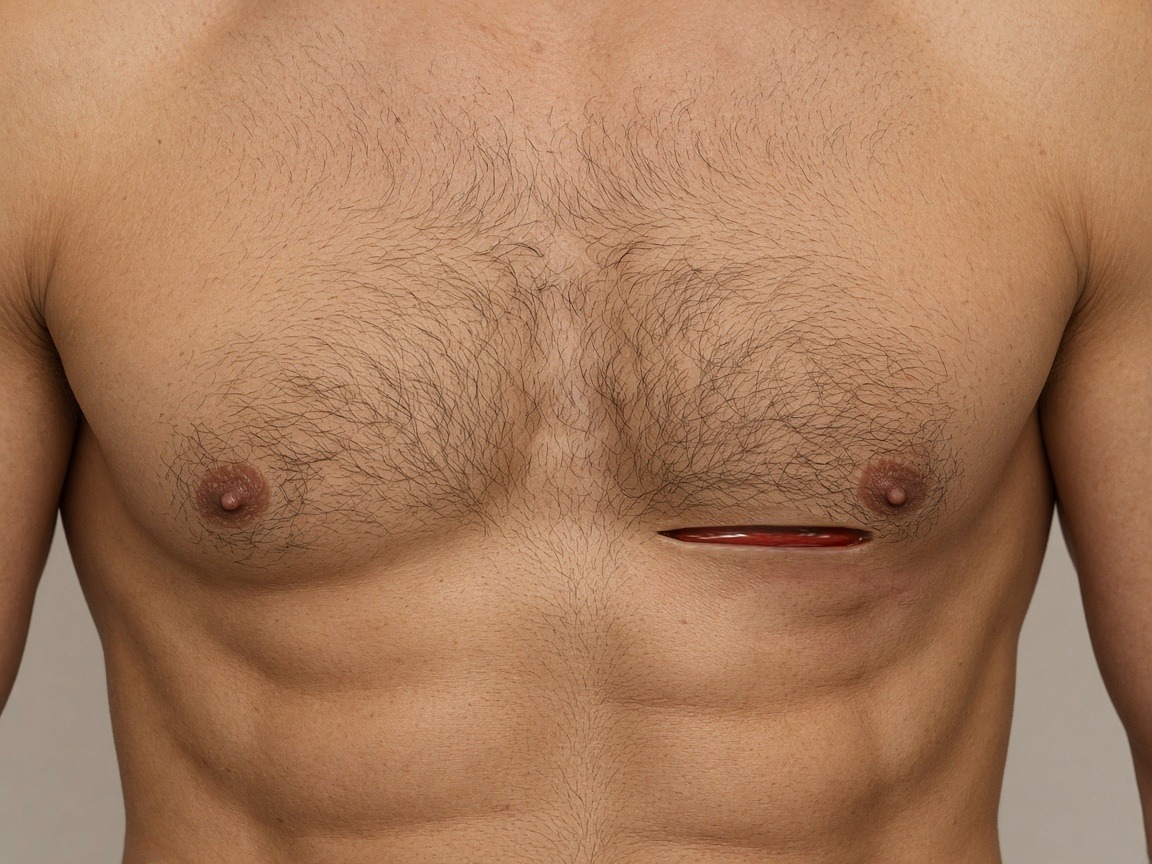
There is no long scar down the middle of the chest. The mark stays on the side of the heart, between the ribs. The incision is usually 6 to 8 centimetres. In women that rib space often falls in the fold under the breast. In men there is no such fold; the incision is simply the space between the ribs that matches where the heart lies. If a robot is used, a few small dot scars are added.
The graft is not a lesser graft. Whether a bypass still works years later depends on the vessel we use, not on how small the cut was. Joining the internal mammary artery, from the inside of the chest wall, to the main artery on the front of the heart (the LAD) is the graft we trust most, in open surgery and in closed surgery. Closed bypass builds that same bridge through a smaller route. A small incision is not a weak bypass. A small incision is also not a promise of a longer life. I explain where grafts are taken in where bypass grafts come from.
Is open bypass worse?
No. I want this to be plain, because “if closed exists, open is outdated” is not true.
Open bypass is harder to recover from, because the breastbone is opened. In return, the surgeon can reach the whole surface of the heart and place a complete set of grafts. When three arteries are diseased, when the heart muscle is weak, when the targets are small and heavily calcified, or when the operation is urgent, a full and safe repair is usually the open one.
Closed bypass is not a comfort procedure. It is the chance, in the right patient, to do the same job through a smaller route. Insisting on it in the wrong patient leads to an incomplete operation. If I tell you that open surgery is safer for you, that is not a step backward. It is the decision that fits your films.
Will my breastbone be cut, and will my heart be stopped?
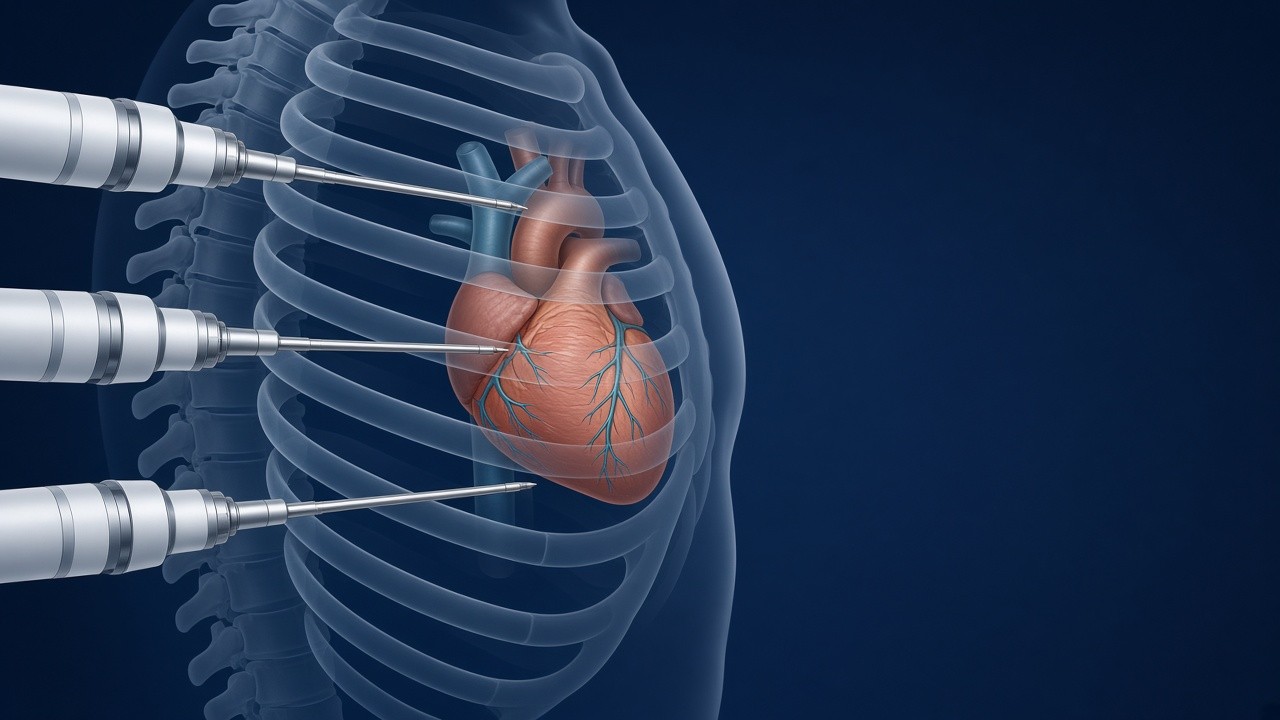
If closed bypass is the plan, the breastbone is not cut. We enter from the front of the chest, between the ribs that overlie the heart. This approach is called an anterior mini thoracotomy. The incision is usually 6 to 8 centimetres. In a woman that line often sits under the breast. In a man it does not; it is the intercostal space that matches the position of the heart. In most single-vessel operations the heart keeps beating, and the heart-lung machine is not needed. We steady only the small area where the stitch will go.
Two situations are different. If more than one artery needs a graft at the same operation, or if we must work inside the heart, the machine may be used. Every closed operation is also prepared so that we can convert to an open one if safety requires it. That conversion is uncommon. When it happens, it is not a failure. It is part of the safety plan.
Can closed bypass be done without a robot?
Yes. Minimally invasive bypass and robotic bypass are not the same thing.
A small-incision bypass is an anterior mini thoracotomy. We enter through an incision of usually 6 to 8 centimetres, between the ribs that overlie the heart, prepare the graft, and sew it to the heart through that same opening.
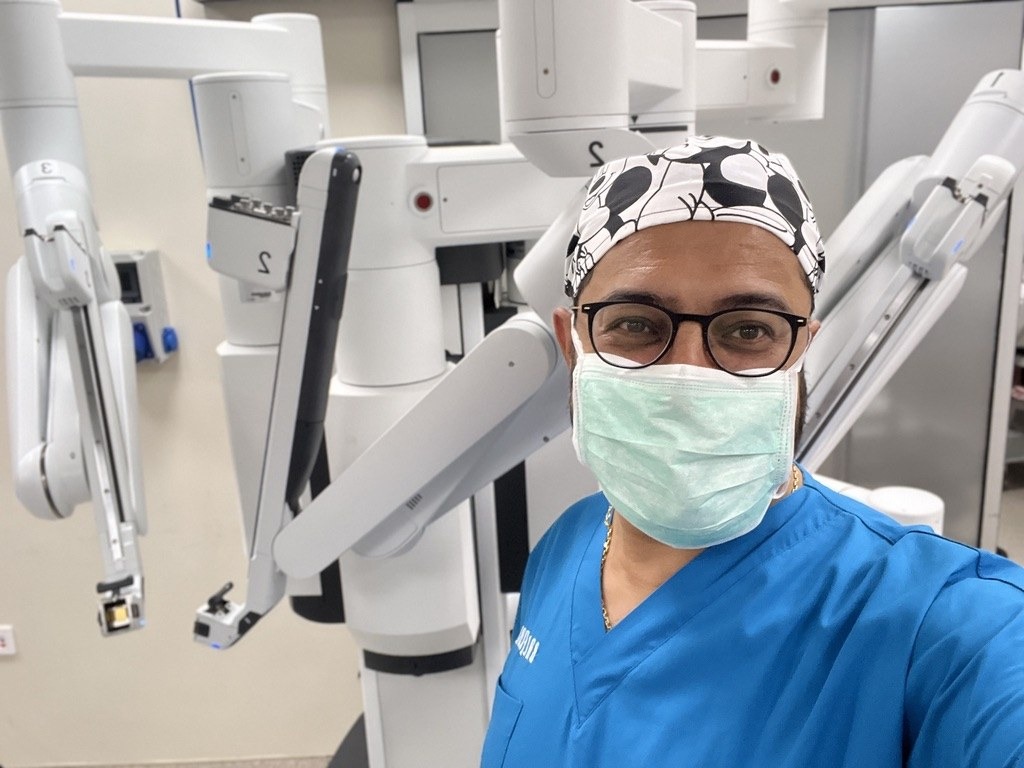
In the robotic operation the graft is prepared through a few small ports, under a magnified view. The stitch to the heart is then placed either through a short incision or, in selected patients, entirely through the ports. The robot does not operate by itself. I control the instruments. I have written about this in what da Vinci adds in robotic bypass and in what we do in robotic coronary surgery.
Which route we choose depends on where your narrowings are, on the shape of your chest, and on whether your lungs can manage one-sided ventilation. Having a robot in the hospital does not make every patient a candidate.
Might I be a candidate?
I cannot answer that without the angiogram. These are the situations in which we talk about closed bypass most often:
- A severe narrowing in the artery on the front of the heart (the LAD), especially near its origin. This is the clearest candidate.
- That artery is a poor place for a stent, a stent has narrowed again, or a surgical graft looks more durable, as it often does in diabetes.
- Another artery is also narrowed, and that one is suitable for a stent. The front artery then receives a closed bypass, and the other receives a stent. This is called hybrid treatment. The cardiologist and I decide it together.
- Diabetes, excess weight, or a problem with the breastbone makes opening the bone an added risk, while the lungs and the target artery still suit a small incision.
- The breastbone was opened before, and the only new graft now needed is to the front artery. Avoiding a second sternotomy can be a real advantage. Not every reoperation fits this plan.
Age by itself is not a barrier. Between a suitable patient at eighty and an unsuitable one at fifty, the choice follows the films, not the calendar.
Who is not a candidate?
In the following situations I usually recommend open bypass, or we talk first about tablets and stents:
- An emergency, a fresh and extensive heart attack, or shock.
- Several arteries severely blocked at the same time, all of them needing a surgical graft.
- A target artery that is very small, solid with calcium, or unsafe to stitch.
- Lung disease too advanced for ventilation of one lung.
- Previous surgery on the same side of the chest, or widespread scarring of the lining of the lung.
Smoking is not an absolute ban, but it changes the decision. Whatever the incision, smoking harms wound healing and the life of the new graft. I ask patients to stop before a date is set.
What happens on the day of surgery?
You are asked not to eat or drink from the night before. In the morning a drip is placed, and the blood tests and films are reviewed again. The operation is done under general anaesthesia. You feel none of it.
When you wake, there is a small incision on the chest, one or more fine drains, and intravenous lines. After a single-vessel closed bypass, most patients spend the first night in intensive care and move to the ward the next day. Sitting up, standing, and breathing exercises start that day or the next. A straightforward recovery in a suitable patient is usually a hospital stay of a few days. At home, pain relief, a blood thinner, and a cholesterol tablet continue. Bypass does not cancel treatment for blood pressure, diabetes, or cholesterol.
You do not have to wait for a breastbone to heal before driving. I still do not want you behind the wheel until the pain has settled enough for a sudden stop. That interval differs from person to person.
What are the risks?
Closed does not mean risk-free. This is heart surgery. Bleeding, rhythm problems, stroke, wound trouble, strain on the kidneys, and, rarely, a risk to life are part of every bypass conversation. The figures change with age, the strength of the heart muscle, and diabetes or kidney disease. I will not quote your number without your films.
Closed bypass adds a few points of its own. One lung is collapsed for part of the operation. Nerves between the ribs can leave numbness or a stabbing feeling around the incision for weeks; most of this fades. If the target artery cannot be reached safely, or if blood pressure or rhythm becomes unstable, we convert to an open operation during the same anaesthetic. We discuss that before the day. It should not be a surprise.
Who makes the decision?
One film is not enough. The coronary angiogram shows where the narrowings are. Echocardiography describes the heart muscle and the valves. When needed, a CT scan shows the chest wall and the internal mammary artery. We also judge whether your lungs will tolerate a small-incision approach.
The final word belongs to the heart team, cardiologist and cardiac surgeon looking at the same films. If you are not a candidate, I say so plainly. If you are, I do not hurry you with the promise of a small cut. Asking for a second opinion is a reasonable thing to do.
The short questions I hear most often
- Is closed bypass a stent? No. A stent sits inside the artery. Bypass sews a new vessel beyond the blockage.
- How many arteries can be treated? The most common and most suitable case is a single artery, especially the one on the front of the heart. In selected patients a second graft, or stents to the other arteries, can be added. Reaching every vessel of three-vessel disease through a small incision is not always possible, and it is not always right.
- Is there an age limit? There is no calendar limit. Heart, lungs, kidneys, and the quality of the target arteries decide.
- I have diabetes. Can I have it? Diabetes is one of the reasons to avoid opening the breastbone, provided the target artery and the lungs are suitable. Diabetes itself should be brought under control before surgery.
- I already have a stent. A stent does not rule out closed bypass. Which artery stays with a stent, and which receives a graft, is a decision we make from the films.
- Will the scar show? Up close, yes. There is no long scar in the midline that shows above an open collar. The incision lies between the ribs and is usually 6 to 8 centimetres.
- Does it stay open for life? A graft made with the internal mammary artery has a high chance of being open years later. That is not a guarantee. Smoking, uncontrolled diabetes, cholesterol, and stopping medication all reduce it.
- When can I walk, and when can I work? Most suitable patients stay in hospital for a few days and start short walks at home straight away. Many people with desk jobs are back within a few weeks. Heavy work takes longer. I set the date for you, not from a chart.
I will not tell you that closed bypass is right for you until we have read your films together. If it fits, I will say why. If it does not, I will explain, in the same plain language, why open surgery or a stent is the better path.