


The terms LDL cholesterol, ApoB and Lp(a) do not mean the same thing. LDL-C reflects the amount of cholesterol carried by the particles, ApoB approximates the number of particles that can enter the arterial wall, and Lp(a) identifies a largely inherited, distinctive particle. This distinction matters for understanding a person’s vascular risk and choosing the right treatment.
In recent years, subcutaneously administered PCSK9 antibodies and the small interfering RNA (siRNA) therapy inclisiran have made it possible to lower LDL cholesterol substantially. However, the mechanisms, dosing intervals, and evidence on heart attack and stroke outcomes of these medicines, often grouped under the name “cholesterol injections,” are not the same.
First, the basic question: Is cholesterol harmful?
Cholesterol is essential for life. It is a component of cell membranes and is used in the production of steroid hormones, bile acids, and vitamin D. The problem is not the existence of cholesterol, but that too much of it circulates for too long within particles that can enter the arterial wall.
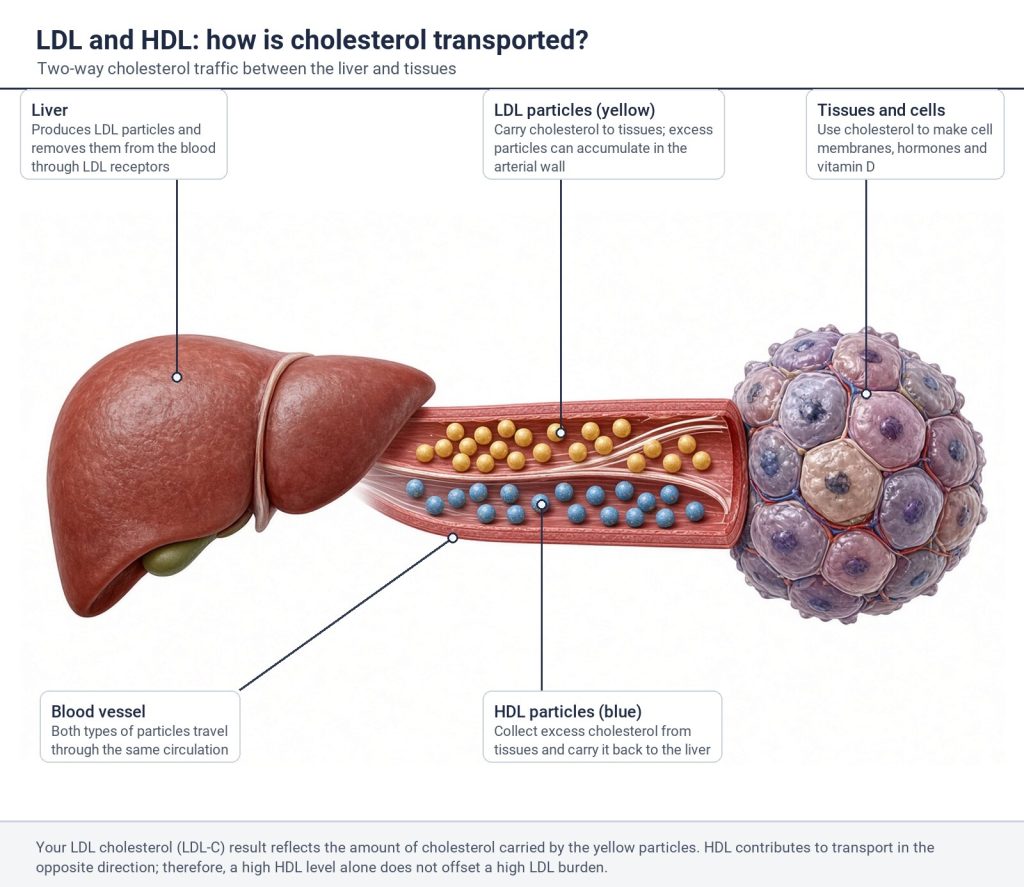
Because fats do not dissolve in water, they cannot travel in the blood on their own. The body packages them into spherical particles called “lipoproteins.” VLDL particles released by the liver shrink as they deliver triglyceride to tissues; some convert to IDL and then to cholesterol-rich LDL. The LDL particle binds to the LDL receptor on the cell surface and is cleared from the blood. This natural transport system exists from the prenatal period onward; it is needed for growth, cell renewal, and energy transport. But when the number of circulating particles and their residence time increase, the system becomes harmful to the arteries.
What is LDL cholesterol (LDL-C)?
LDL-C estimates “how much cholesterol in total is carried inside LDL particles.” In everyday language it is called bad cholesterol; a more accurate phrase is the cholesterol carried by LDL particles. The laboratory result is usually reported in mg/dL.
Not every LDL particle carries the same load. Two people may have the same LDL-C, yet one may have few cholesterol-packed particles and the other many particles carrying less cholesterol. For this reason, LDL-C is a very valuable measurement but does not always show the whole picture.
Why does LDL-C rise?
- Heredity: In conditions such as familial hypercholesterolemia, the LDL receptor or related pathways may be affected from birth.
- Diet: Excess intake of saturated and trans fats in particular raises LDL-C substantially in some people.
- Weight gain and physical inactivity: Especially together with insulin resistance, these can increase production of atherogenic particles.
- Illnesses: Hypothyroidism, nephrotic syndrome, chronic kidney disease, and liver diseases that impair bile flow are important.
- Pregnancy and some medicines: Corticosteroids, some immunosuppressants, retinoids, and some diuretics can affect the lipid profile.
Especially if LDL-C is 190 mg/dL or higher, if there is a family history of premature heart attack, or if the value has risen unexpectedly, focusing on diet alone is not enough; familial and secondary causes should be investigated.
What is ApoB, and why can it be thought of as a “particle counter”?
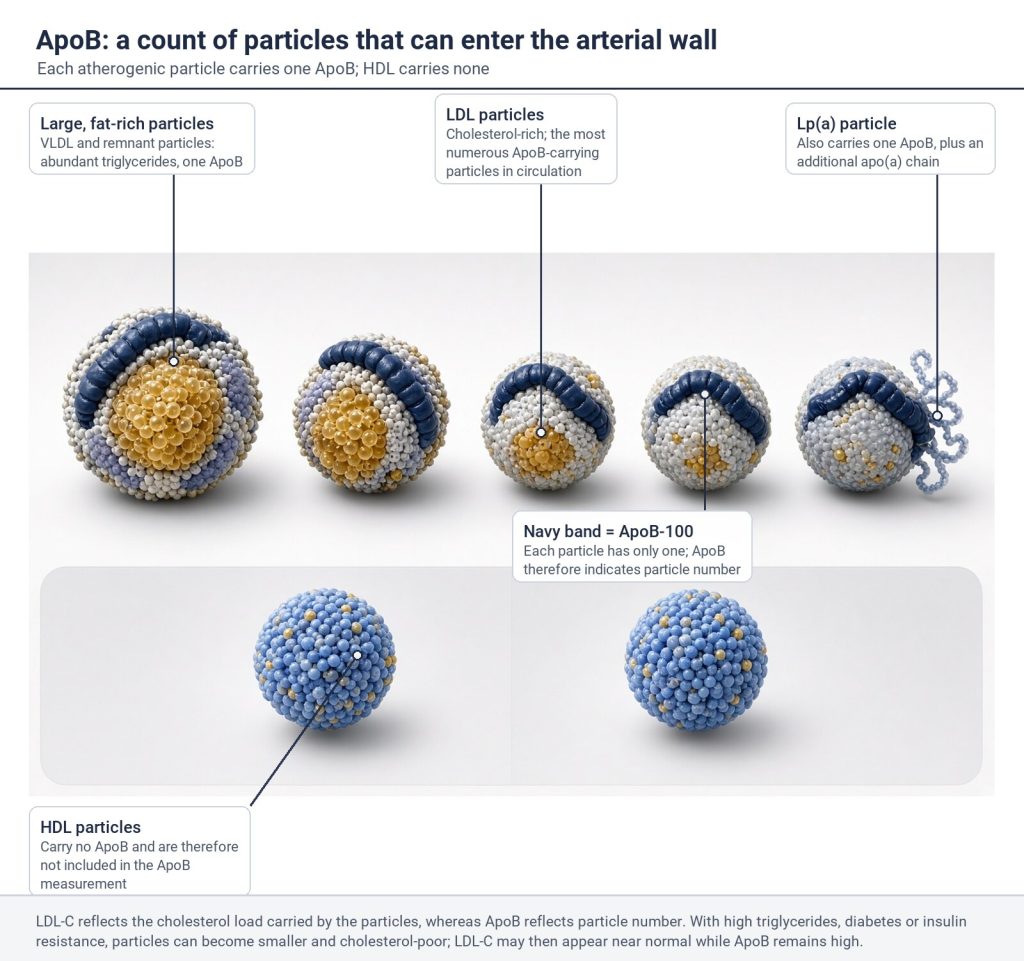
Apolipoprotein B is the structural protein of lipoproteins that can cause atherosclerosis. Each VLDL, remnant particle, IDL, LDL, and Lp(a) particle contains one ApoB molecule. Therefore the amount of ApoB in blood is a practical indicator of the total number of particles with the potential to enter the arterial wall.
In a simple analogy, LDL-C shows the total cargo carried by trucks on the road; ApoB shows the number of trucks. For the arterial wall, both the cargo and the number of vehicles that have a chance to hit the wall matter. The more particles there are, the greater the chance they will enter the arterial wall and be retained there.
Can ApoB be high while LDL-C looks normal?
Yes. Especially with elevated triglycerides, abdominal obesity, type 2 diabetes, metabolic syndrome, and insulin resistance, particles may be smaller and poorer in cholesterol. LDL-C may look “not very high” while ApoB—that is, particle number—remains high. When LDL-C and ApoB disagree, studies suggest that vascular risk is often more closely related to ApoB.
Therefore ApoB measurement is particularly useful in people with high triglycerides, diabetes or obesity, suspected metabolic syndrome, or in whom remaining risk needs to be assessed even though treatment has lowered LDL-C substantially. In the European guideline, secondary ApoB targets according to a person’s total risk are <100 mg/dL at moderate risk, <80 mg/dL at high risk, and <65 mg/dL at very high risk. These are not a standalone prescription for everyone; the target is set together with individual risk.
What is lipoprotein(a) — Lp(a)?
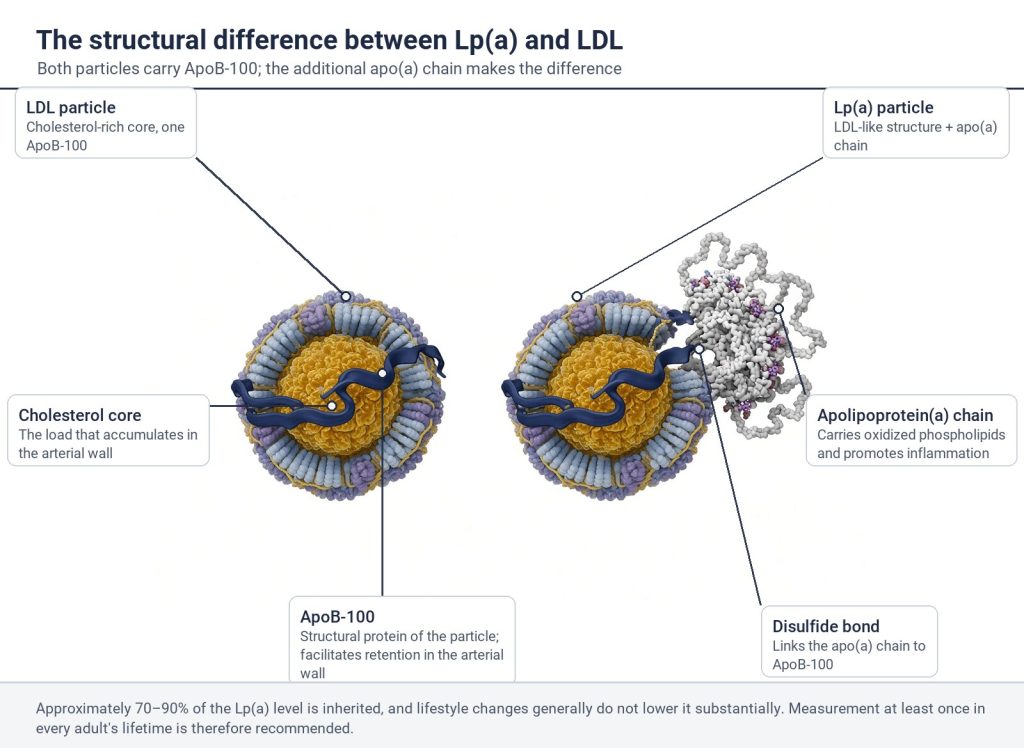
Lp(a) is formed when an additional protein called apolipoprotein(a) is attached to an LDL-like particle. It also carries one ApoB. Besides being able to deposit cholesterol in the arterial wall, it is associated with atherosclerosis because it carries oxidized phospholipids and promotes inflammatory processes. High Lp(a) increases the risk of heart attack and ischemic stroke as well as calcific aortic stenosis.
Lp(a)’s indispensable physiological role in human biology is not clear. The existence of people who live with very low levels suggests that high Lp(a) is not a level the body “needs.”
When does Lp(a) appear, and why does it rise?
Lp(a) is detectable in newborns; genetic production becomes pronounced in the first years of life, and in most people it approaches adult levels during childhood. Heredity determines about 70–90% of the level. Therefore high Lp(a) is usually not the result of a person’s poor diet, but a trait they carry from birth.
In adults it is generally stable. However, kidney disease, nephrotic syndrome, marked hypothyroidism, pregnancy, menopause, and active inflammatory states can affect the measurement. If the result is clinically unexpected or was measured during these conditions, reassessment at an appropriate time may be needed.
The 2025 ESC/EAS update recognizes an Lp(a) >50 mg/dL (approximately >105 nmol/L) level as a factor that increases risk. Risk does not begin at a sharp cutoff; it increases gradually as the level rises. mg/dL and nmol/L should not be converted into each other reliably with a fixed coefficient, because particle structure varies from person to person. The result should be interpreted in the unit provided by the laboratory.
When should Lp(a) be measured?
The European Atherosclerosis Society recommends that every adult have Lp(a) measured at least once in a lifetime. Measurement becomes even more important if there is premature cardiovascular disease, familial hypercholesterolemia, a family history of premature heart attack/stroke, unexplained recurrent vascular events, or calcific aortic stenosis. When a high result is found, measuring first-degree relatives may also be considered.
How do these values damage the arterial wall?
ApoB-containing particles can cross the inner layer of arteries and be retained beneath the wall. When they are modified there, the immune system is activated. Lipid-laden foam cells, inflammation, and connective tissue gradually form the atherosclerotic plaque. The plaque may slowly narrow the artery, or its surface may rupture suddenly, leading to clot formation, heart attack, or stroke.
This process is related more to cumulative lifetime exposure than to a single high result. The question “how high, and for how long?” matters. When smoking, high blood pressure, diabetes, and kidney disease coexist, the same LDL-C or ApoB level can mean greater absolute risk.
How can LDL-C and ApoB be lowered without medicines?
Lifestyle is the foundation of every treatment; however, in genetically very high LDL-C or in a person with established cardiovascular disease, it may not replace medication.
- Replace saturated fat with unsaturated fat: Reducing butter, sheep tail fat, processed meat, and full-fat dairy, and turning toward sources such as olive oil, nuts, seeds, and fish, is more meaningful than eating “low-fat” alone.
- Increase soluble fiber: Oats, barley, legumes, vegetables, fruit, and, in suitable people, psyllium can help reduce intestinal reabsorption of bile acids.
- Build a plant-forward Mediterranean-style pattern: Emphasize vegetables, fruit, whole grains, legumes, nuts, and fish; limit ultra-processed products, trans fat, and refined carbohydrate.
- Reduce excess weight: A decrease in abdominal (waist) fat in particular is useful in insulin resistance accompanied by high triglycerides and ApoB.
- Move regularly: At least 150 minutes per week of moderate-intensity aerobic activity plus muscle strengthening reduces overall vascular risk. Even if the direct effect of exercise on LDL-C is limited, it provides important benefit through blood pressure, insulin sensitivity, and weight.
- Do not smoke: Although smoking does not greatly change LDL particle number, it increases the harm of particles in the arterial wall and the risk of clotting.
The response varies from person to person. A well-implemented dietary pattern produces a modest LDL-C drop in most people and a more marked drop in some. Products such as red yeast rice, assumed to be safe because they are “natural,” may contain variable amounts of a statin-like substance; because of quality, interaction, and side-effect issues, they should not be regarded as a drug alternative without a physician’s advice.
Does Lp(a) fall without medicines?
Usually no. Healthy eating, weight control, and exercise may not lower Lp(a) to a meaningful extent. This does not mean lifestyle is useless. Even if Lp(a) does not change, good control of modifiable risks such as LDL-C/ApoB, blood pressure, blood glucose, and smoking can reduce total risk.
How do other cholesterol medicines affect LDL-C, ApoB and Lp(a)?
| Treatment | Overall effect on LDL-C and ApoB | Overall effect on Lp(a) | Important note |
|---|---|---|---|
| Statins | Powerful reduction depending on dose; they are foundational therapy | Usually neutral, sometimes a small increase | They have the broadest evidence for reducing heart attack and stroke. They are not discontinued because of a small increase in Lp(a). |
| Ezetimibe | Reduces intestinal cholesterol absorption; usually lowers LDL-C by an additional 15–25% | No meaningful effect | Can be added to a statin or be an alternative in a suitable patient. |
| Bempedoic acid | Acts at an earlier step of cholesterol synthesis in the liver; about a 15–25% reduction | Usually neutral | May be chosen in people who cannot use a statin or who do not reach target; it can raise uric acid. |
| Bile acid sequestrants | Lower LDL-C and ApoB | No meaningful effect | May raise triglycerides and affect the absorption of other medicines. |
| Fibrates / omega-3 products | Their main effect is on triglycerides; the LDL-C and ApoB response varies by product and patient | A meaningful reduction is not expected | They are not treatments that replace “cholesterol injections.” |
| Niacin | May lower LDL-C somewhat | May lower it by about 20–30% | Because it has not shown clinical benefit when added to modern therapy, and because of side effects, it is not routinely recommended solely to lower Lp(a). |
| PCSK9 antibodies | About a 50–60% LDL-C reduction and a marked ApoB reduction | Average 20–30% reduction | Outcomes trials showing a reduction in cardiovascular events exist for evolocumab and alirocumab. |
| Inclisiran | About a 50% LDL-C reduction and around a 40% ApoB reduction | In studies usually a modest reduction of about 15–25% | Its LDL-lowering effect is proven; the heart attack–stroke outcomes trial has not concluded as of September 2026. |
Percentages are study averages; they vary with baseline value, concomitant therapy, genetic traits, and adherence. Medicines are not simple substitutes for one another; they are often used together to complete different steps of the same biological pathway.
How do next-generation subcutaneous cholesterol medicines work?
1. PCSK9 monoclonal antibodies: evolocumab and alirocumab
We can think of LDL receptors in the liver as “recycling gates” that capture LDL particles from the blood and take them into the cell. Normally the receptor can return to the surface and capture another LDL particle.
When the PCSK9 protein binds this receptor, it sends it not to recycling but to the cell’s degradation compartment. Evolocumab and alirocumab are antibodies that capture PCSK9 in the blood. As a result, more LDL receptors return to the surface, the liver clears more LDL from the blood, and LDL-C and ApoB fall.
- Administration: Usually subcutaneously every two weeks or once a month, depending on the product and dose.
- Effect: When added to existing statin/ezetimibe therapy, typically an additional 50–60% reduction in LDL-C.
- Evidence: In the FOURIER trial, evolocumab, and in the ODYSSEY OUTCOMES trial, alirocumab, reduced major cardiovascular events in appropriate high-risk patients.
- Side effects: Most commonly pain, redness, or tenderness at the injection site; serious allergic reactions are rare.
2. Inclisiran: an siRNA that silences the instruction to produce PCSK9
Inclisiran is not an antibody. It is a small interfering RNA directed to the liver cell. By degrading the messenger RNA used to produce PCSK9, it reduces production of the protein. In other words, while the antibody captures circulating PCSK9 protein, inclisiran temporarily silences the liver’s instruction to make this protein.
This process does not change DNA and is not gene editing. The effect wanes over time; therefore repeat dosing is required.
- Administration: First dose, second dose at month 3, and thereafter subcutaneously every 6 months; conditions of use may vary by country.
- Effect: In the ORION-10 and ORION-11 trials, LDL-C fell by about 50%; smaller reductions in ApoB and Lp(a) were also seen.
- Evidence limit: That it lowers LDL-C is clear. However, results of the ORION-4 cardiovascular outcomes trial are expected in spring 2027. Therefore it is not accurate, as of September 2026, to say that “it has been directly proven to reduce heart attack and stroke.”
- Side effects: Injection-site reactions are most common; in the trials most were mild and transient.
For whom might these injections be considered?
The decision is not made by looking at a single cholesterol result alone. In general, they may come up after specialist assessment in the following situations:
- People with heart attack, ischemic stroke, peripheral artery disease, or other atherosclerotic vascular disease who do not reach target despite appropriate oral therapy,
- Those with familial hypercholesterolemia,
- Those at very high risk in whom the required LDL-C/ApoB reduction cannot be achieved with oral medicines,
- Selected patients who cannot use adequate therapy because of true, documented drug intolerance.
In most patients the sequence is the highest-intensity statin that is tolerated, then ezetimibe, and additional therapy if needed. In very high-risk situations such as acute coronary syndrome, combination therapy may be started earlier. Which medicine is appropriate is assessed together with the magnitude of reduction needed, prior vascular events, kidney and liver status, possibility of pregnancy, drug interactions, preference regarding administration, and reimbursement conditions.
Where do new injections that target Lp(a) stand?
siRNA medicines such as olpasiran and lepodisiran, by targeting hepatic production of apolipoprotein(a), were able to lower Lp(a) by more than 90% in early-phase studies. However, lowering a laboratory value and showing a reduction in heart attack and stroke are not the same thing. Large outcomes trials of these medicines are ongoing, and they are not yet standard Lp(a) therapy.
Important 2026 update: The antisense medicine pelacarsen lowered Lp(a) in the Lp(a)HORIZON phase III trial; but according to the topline results announced on 4 September 2026, it did not significantly reduce the primary cardiovascular endpoint. Because detailed peer-reviewed results have not yet been published, this finding cannot be interpreted as “Lp(a) does not matter” or “other candidates are also ineffective.” The correct conclusion is this: with which medicine, by how much, how early, and in which patient group lowering Lp(a) will translate into clinical benefit is still being investigated.
Which value should be targeted?
A single “normal LDL” value does not apply to everyone. In European guidelines the LDL-C target is set according to a person’s total risk. In the general framework, high risk aims for at least a 50% reduction from baseline and <70 mg/dL; very high risk aims for at least a 50% reduction and <55 mg/dL. In appropriately selected people who have had a recurrent vascular event within two years, <40 mg/dL may be considered.
By contrast, a young person with no other risk factors and a person who has had a heart attack and has diabetes and kidney disease do not carry the same risk with the same result. The treatment target should be personalized by assessing age, blood pressure, smoking, diabetes, kidney disease, family history, vascular disease on imaging, LDL-C, ApoB, and Lp(a) together.
Frequently asked questions
If LDL-C is low, is ApoB measurement still needed?
It is not required in everyone. If triglycerides are high, or if there is diabetes, obesity, metabolic syndrome, or very low LDL-C on treatment, the two measurements may disagree; ApoB can then show residual particle risk.
If Lp(a) is high, should the statin be stopped?
No. Although a statin may raise Lp(a) slightly in some people, the cardiovascular benefit far outweighs this small change. It should not be stopped without consulting a physician.
Are cholesterol injections used instead of a statin?
In most people they are used not instead of a statin, but in addition to a statin and/or ezetimibe when an adequate reduction is not achieved. Different combinations may be considered in selected people with statin intolerance.
Is inclisiran a vaccine or gene therapy?
No. It is not a vaccine that trains the immune system, nor is it gene therapy that changes DNA. It is an siRNA medicine that temporarily reduces the messenger RNA used to produce PCSK9 in the liver.
Can I convert my Lp(a) result from mg/dL to nmol/L?
There is no single reliable conversion factor. Apo(a) structure varies from person to person. The result should be interpreted according to the unit and method used by the laboratory.
Conclusion
LDL-C, ApoB and Lp(a) are not rivals of one another, but measurements that show different aspects of the same risk. LDL-C describes the cholesterol load being carried, ApoB the number of particles that can enter the arterial wall, and Lp(a) mostly an additional inherited risk. Lifestyle is foundational in all patients; however, in high hereditary risk or established vascular disease it may not be sufficient on its own.
Next-generation subcutaneous medicines are powerful options. PCSK9 antibodies both lower LDL-C substantially and reduce cardiovascular events in appropriate patients. Inclisiran can make LDL-C control easier with a six-month maintenance interval; however, the evidence limit should be stated accurately until clinical event results are reported. Medicines specific to Lp(a), despite promising laboratory effects, are still at the research stage with respect to clinical benefit.
This article is for general information; it is not a personal diagnosis or treatment recommendation. Consult your physician before starting, stopping, or changing the dose of any medicine.
Scientific sources
- Mach F, Koskinas KC, Roeters van Lennep JE, et al. 2025 Focused Update of the 2019 ESC/EAS Guidelines for the management of dyslipidaemias. Atherosclerosis. 2025.
- Mach F, Baigent C, Catapano AL, et al. 2019 ESC/EAS Guidelines for the management of dyslipidaemias. European Heart Journal. 2020;41:111–188.
- Kronenberg F, Mora S, Stroes ESG, et al. Lipoprotein(a) in atherosclerotic cardiovascular disease and aortic stenosis: EAS consensus statement. European Heart Journal. 2022;43:3925–3946.
- Soffer DE, Marston NA, Maki KC, et al. Role of apolipoprotein B in the clinical management of cardiovascular risk in adults. Journal of Clinical Lipidology. 2024.
- Ray KK, Wright RS, Kallend D, et al. Two Phase 3 Trials of Inclisiran in Patients with Elevated LDL Cholesterol. New England Journal of Medicine. 2020;382:1507–1519.
- Sabatine MS, Giugliano RP, Keech AC, et al. Evolocumab and Clinical Outcomes in Patients with Cardiovascular Disease. New England Journal of Medicine. 2017;376:1713–1722.
- Schwartz GG, Steg PG, Szarek M, et al. Alirocumab and Cardiovascular Outcomes after Acute Coronary Syndrome. New England Journal of Medicine. 2018;379:2097–2107.
- O’Donoghue ML, Fazio S, Giugliano RP, et al. Lipoprotein(a), PCSK9 Inhibition, and Cardiovascular Risk. Circulation. 2019;139:1483–1492.
- O’Donoghue ML, Rosenson RS, Gencer B, et al. Small Interfering RNA to Reduce Lipoprotein(a) in Cardiovascular Disease. New England Journal of Medicine. 2022;387:1855–1864.
- Nissen SE, Wolski K, Balog C, et al. Lepodisiran — A Long-Duration Small Interfering RNA Targeting Lipoprotein(a). New England Journal of Medicine. 2025;392:1673–1683.
- Lichtenstein AH, Appel LJ, Vadiveloo M, et al. 2021 Dietary Guidance to Improve Cardiovascular Health. Circulation. 2021;144:e472–e487.
- Novartis. Lp(a)HORIZON Phase III topline results. 4 September 2026. A detailed peer-reviewed publication is awaited.
Last scientific update: 21 September 2026.