

Last week a patient turned her phone toward me in clinic. An ad on the screen: “Beat lipedema in 8 sessions.” Underneath, in smaller letters, ESWT. Her question was simple. “Doctor, will this machine melt the fat in my legs?”
Short answer: it will not melt fat. It may reduce pain — and in lipedema the real complaint is usually not the tape measure. It is the ache that arrives when someone touches the leg.
Talking about ESWT without drawing that line is how you send a patient home with the wrong hope. So here is where the evidence sits, what has actually been shown, and what still has not.
A note before we go on: this is general medical writing, not a personal treatment plan. Sudden one-sided swelling with redness, warmth or breathlessness is not an ESWT question. That is an urgent assessment.
What ESWT actually is
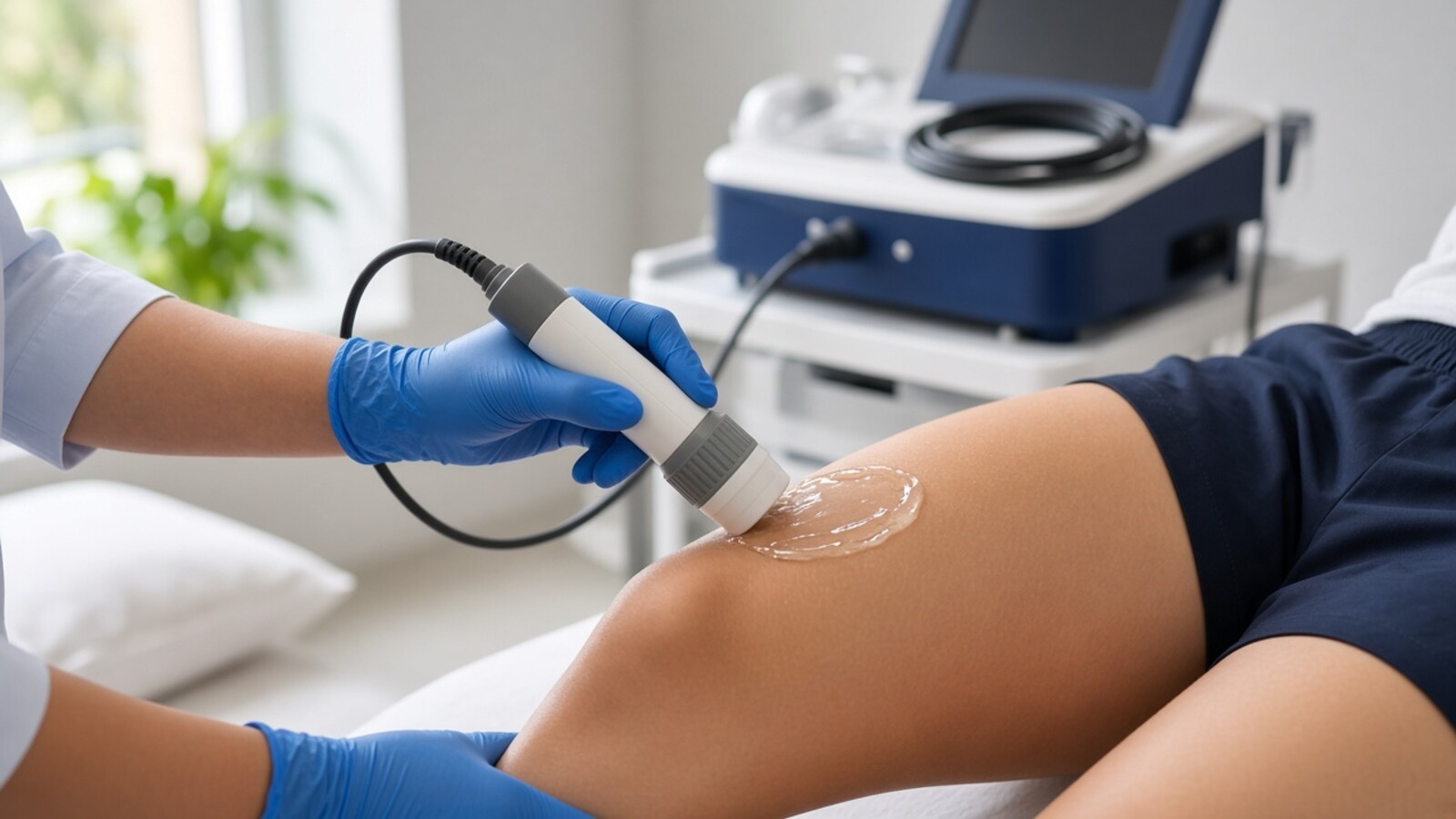
Pressure waves generated outside the body and delivered into tissue. Despite the name, there is no electrical shock and no heat. It is mechanical vibration.
The technology was born from breaking kidney stones. It moved into orthopedics next — plantar fasciitis, tennis elbow, calcific shoulder. On the vascular side it is being tried in wounds that will not close, because it has been shown to stimulate local blood flow and growth factors.
Two main types get mixed up constantly:
- Focused ESWT concentrates energy at a point in depth and can reach about four centimeters down.
- Radial ESWT spreads energy near the surface across a wider area. This is the type used for superficial fat and connective tissue.
Lipedema protocols usually use a radial handpiece; some centers combine defocused and radial heads. So there is no single “ESWT.” Change the device, the energy level or the number of pulses and you have changed the treatment.
Why lipedema ends up in ESWT’s territory
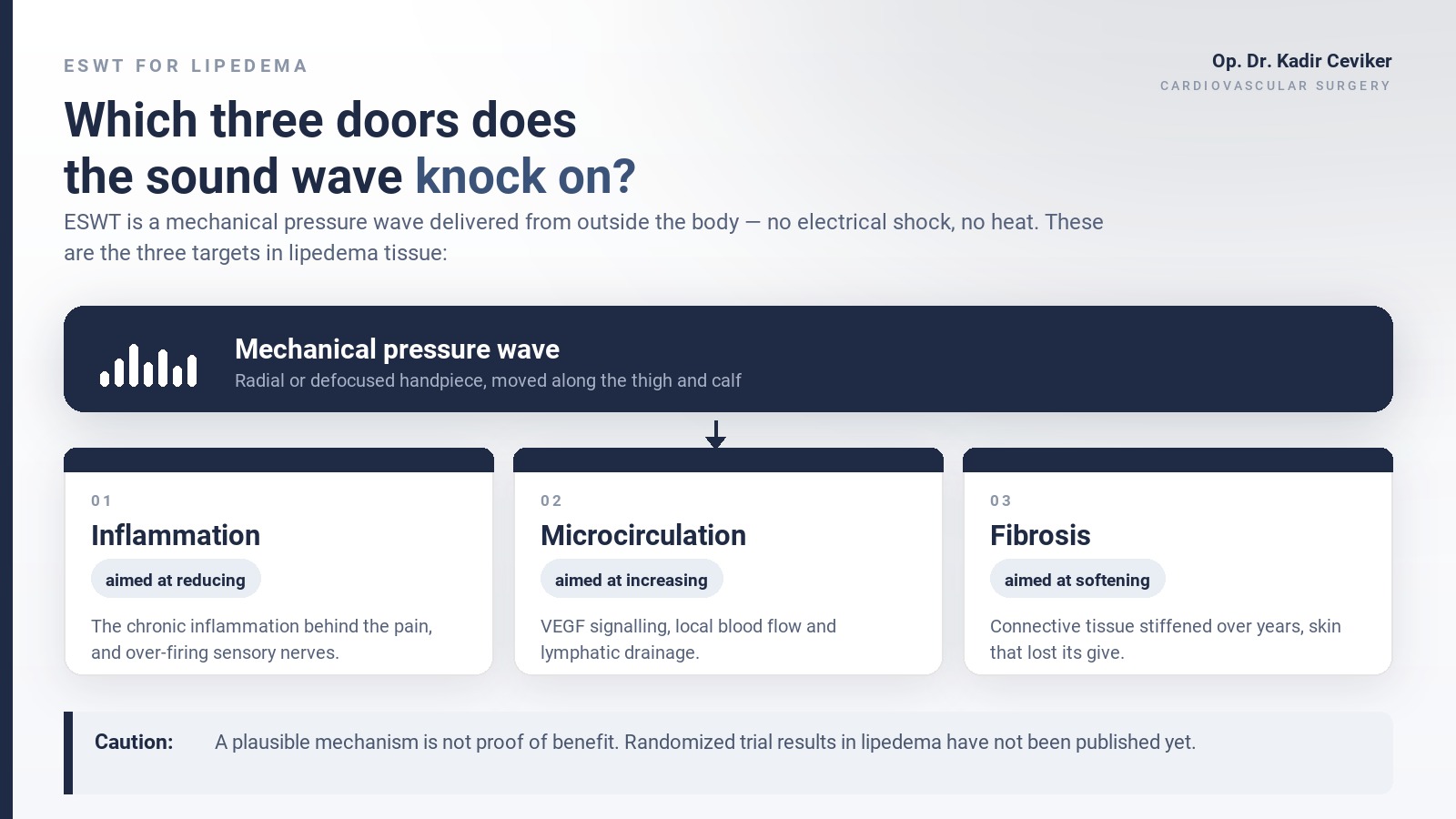
Because lipedema is not simply excess fat. Inside that tissue there is chronic low-grade inflammation, leaky small vessels, fluid escaping into the interstitium, and connective tissue that stiffens over the years. The pain comes from there — with touch, with pressure, after standing too long.
Those are exactly the doors ESWT knocks on: inflammation, microcirculation, lymphatic flow, fibrosis. In animal and laboratory work, shockwaves increased lymphatic growth signals such as VEGF-C and softened the TGF-β pathway, which is the fibrosis pathway.
Let me say it plainly, though: “the mechanism makes sense, therefore the treatment works” is the trap medicine falls into most often. A plausible hypothesis and a proven benefit are different animals. The question that matters is what happened in people.
Where the evidence really stands
The honest summary: promising, but thin. In order.
2005 — the first signal. Siems and colleagues reported that after a series of shockwave sessions in lipedema and cellulite, markers of oxidative stress in serum fell and the biomechanical properties of the skin improved. A small study, but the first serious hint on the fibrosis side.
2023 — the Rome pilot. Fifteen women with stage 2 lipedema received eight sessions combining defocused and radial ESWT, mesotherapy and lymph taping. Pain scores dropped from 6.9 to 1.5 and were still 1.8 at six months. Limb circumferences, quality of life, ultrasound tissue thickness and elasticity all improved.
The numbers look impressive. Two caveats: there was no control group, and ESWT was not given alone. Three treatments ran together, so we cannot say how much of the benefit belonged to the sound waves.
2026 — the cold shower. This time one leg of each patient received radial ESWT while the other leg served as the internal control. Twelve patients completed follow-up. Function, quality of life and physical activity improved significantly at three months. But tissue thickness on ultrasound, elastography and bioimpedance showed no significant change, and no difference emerged between the treated and untreated leg.
I read that result this way: the patient feels better, while the measurable structure of the tissue may be staying the same.
Randomized trials? On the way. Studies comparing standard conservative care with and without added ESWT are registered, and results are not published yet. As of today there is no guideline sentence recommending ESWT for lipedema. If someone selling it tells you otherwise, ask for the citation.
“But will I lose centimeters?”
Combined protocols did report falling limb circumferences, yes. Two things need separating here: that is not weight loss, and it is not fat melting. The drop most likely reflects less interstitial fluid and swelling, plus some tissue remodeling.
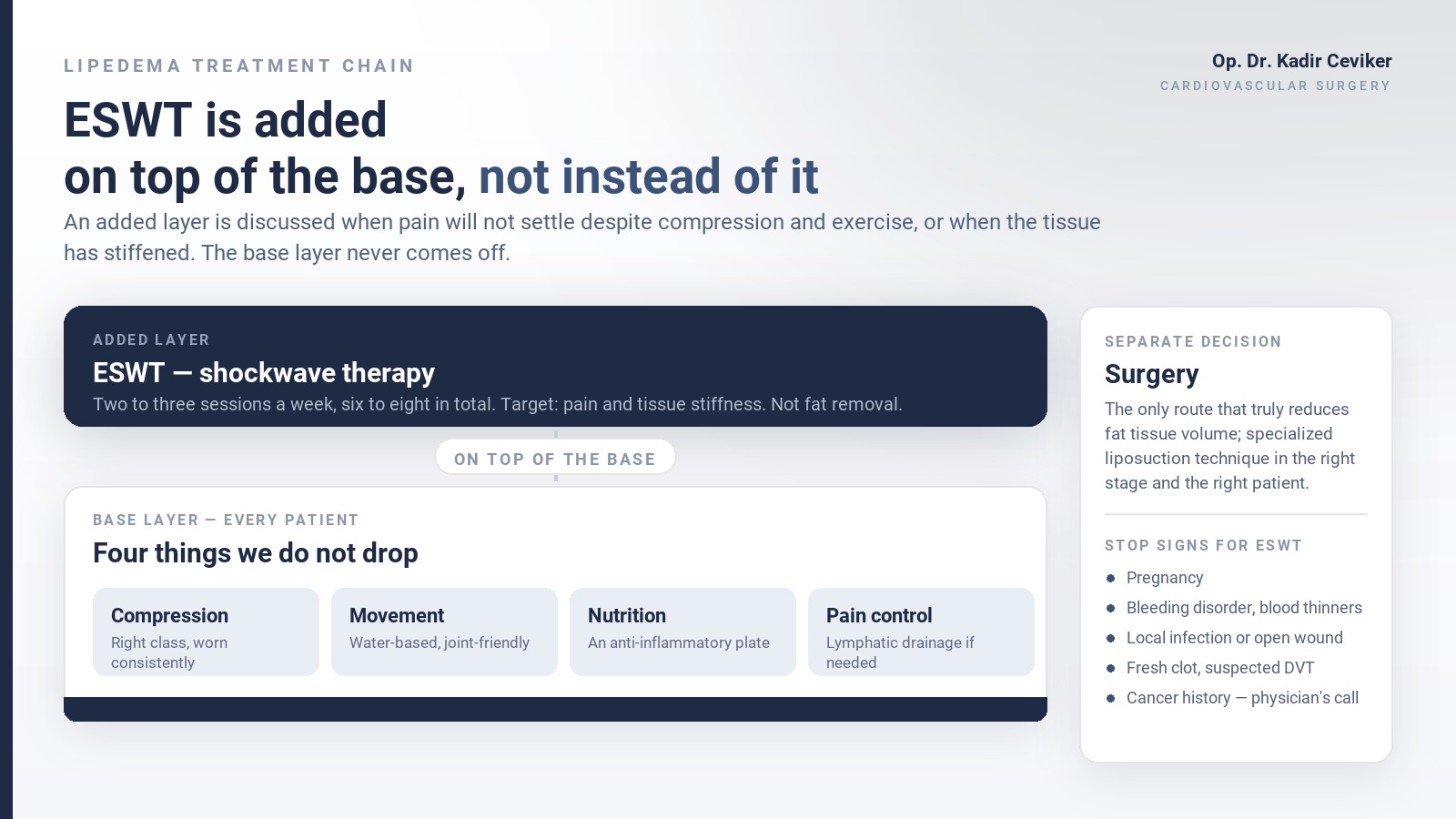
The sentence I hear most in clinic is this: “I diet, my upper body shrinks, my legs stay.” That pattern is the signature of lipedema, and ESWT does not erase the signature. The only approach that genuinely reduces the volume of that fat tissue, in the right patient, is specialized liposuction technique.
So manage expectations honestly. ESWT is not a leg-slimming machine. It is a supportive treatment aimed at pain and tissue stiffness.
Its most concrete use? After surgery
Oddly enough, the clearest data on ESWT is not in lipedema itself. It is in the period after lipedema surgery.
Fibrosis after liposuction is a real problem — hard palpable bands, pain, skin that loses its give. In a prospective study published in 2025, fifty patients with stage 2-3 lipedema received ESWT three times a week for three weeks, starting one week after surgery, while twenty-five served as controls. The ESWT group had markedly less fibrosis on elastography, better skin elasticity, lower pain scores and higher satisfaction.
Controlled, though still not randomized. Even so, this looks like the most defensible clinical use today: supporting recovery after surgery.
What a session is actually like
Published protocols run two to three sessions a week, six to eight in total. A leg session can take 20 to 50 minutes. No anesthesia, no needles — gel goes on and the handpiece is moved across the area.
You feel it, but it is tolerable. Energy is set to what the patient can take; there is no rule that more pain means more benefit. Afterwards you may get transient redness, mild tenderness, sometimes small bruises. No serious adverse events were reported in these studies.
One more note: finishing eight sessions does not finish the job. Lipedema is chronic. Be careful with any clinic selling a session package as a cure that stands apart from compression and movement.
Who should not have it
ESWT looks harmless, but there are situations where I say stop:
- Pregnancy.
- Bleeding disorders or blood thinners.
- Active infection, open wound or bone infection in the treatment area.
- A history of cancer — that call belongs to the treating physician.
- Suspected deep vein thrombosis or a fresh clot.
- Pacemakers and similar implants, without checking the device warnings.
And a diagnostic caution: not every swollen leg is lipedema. Swelling that involves the feet, sits on one side, or pits under your thumb needs the right diagnosis first. I walked through that distinction in lipedema vs lymphedema, and the symptom picture is in lipedema symptoms.
Where ESWT belongs in the treatment chain
The backbone of lipedema treatment has not moved: compression, regular joint-friendly movement — water-based exercise especially —, an anti-inflammatory eating pattern, pain management, lymphatic drainage where indicated, and surgery in the right patient.
ESWT does not replace that backbone. It is a layer added on top, considered for the patient whose pain will not settle despite compression and exercise, whose tissue has stiffened, or who is recovering from surgery.
If the eating side is what you are after, I opened up the plate in the lipedema nutrition guide. The weight-loss injection question has its own piece: lipedema, weight loss injections, diet and exercise.
Your stage, your pain level and whether ESWT suits you is an examination conversation — you can request an appointment from the contact page.
Frequently asked questions
Does ESWT for lipedema melt fat?
No. The studies show improvement in pain and function, not lasting loss of fat tissue volume. Reductions in circumference relate more to fluid and swelling.
How many sessions are needed?
Published protocols use six to eight sessions, two or three per week. There is no single standard; device and energy settings vary between centers.
Can I stop wearing compression garments?
Do not. ESWT does not replace compression — in the studies it was applied alongside it.
Should I have ESWT after surgery?
That is your surgeon’s call. The most concrete data sits here, in post-liposuction fibrosis and pain, but timing and session count are planned with the operating team.
Is it covered by insurance?
For a lipedema indication, usually not; most centers charge out of pocket. Before buying a session package, get the total cost and the expected outcome in writing.
Scientific sources
- Siems W et al. Anti-fibrosclerotic effects of shockwave therapy in lipedema and cellulite — BioFactors, 2005
- Michelini S et al. Defocused and radial shockwave therapy, mesotherapy and kinesio taping in lipedema: a pilot study — Lymphology, 2023
- Clinical, ultrasound, elastography and bioimpedance changes after radial ESWT: a within-patient study — Phlebology, 2026
- Early shockwave therapy after liposuction in lipedema: a prospective study — Phlebology, 2025
- Kruppa P et al. Lipedema: pathogenesis, diagnosis and treatment options — Deutsches Ärzteblatt International, 2020
- ESWT for primary lipedema: randomized controlled trial protocol — ClinicalTrials.gov NCT07240415