

Where Do Bypass Grafts Come From? Chest, Arm, and Leg Conduits
When we talk through bypass surgery, I often see the same look on a patient’s face: “Fine — bypass. But where do bypass grafts come from? My leg? Will my arm be harmed? Will I have a long scar down my leg?”
It is a fair question. Bypass is not “cleaning out” a blocked coronary artery from the inside. It builds a new route beyond the blockage. That route is usually made from one of your own vessels. Which vessel we choose — and whether a leg vein is taken openly or endoscopically — affects how durable the bridge may be and how the harvest site feels afterward.
Disclaimer: This article is general education. Graft choice depends on anatomy, vessel quality, and other conditions, and is decided with the surgical team.
If you are still deciding on treatment, see stent or bypass for coronary artery disease. For the weeks after surgery, see recovery after bypass surgery.
What does “graft” mean in bypass surgery?
Short answer: A graft is the bridge vessel that carries blood past a blocked segment.
Think of a closed tunnel on a highway. Instead of digging the tunnel open, you take a side road around it. In CABG, that side road is often a vessel taken from elsewhere in your body — the graft.
Where do bypass grafts come from — which vessels are used most often?
Short answer: Most often the chest artery (LIMA), the saphenous vein from the leg, and in selected patients the radial artery from the arm.
Three families: LIMA (sometimes RIMA) from the inner chest wall, saphenous vein from the leg, radial artery from the forearm. There is no single shopping list — the angiogram, vessel quality, diabetes, and prior operations all shape the plan.
Why is the chest artery (LIMA) mentioned so often?
Short answer: In suitable patients it has strong long-term patency, especially for the front-wall artery (LAD).
Patients sometimes remember LIMA as “the artery from the chest.” Being an artery matters: its flow characteristics suit coronary circulation well. The 2021 ACC/AHA/SCAI revascularization framework also underscores the value of arterial grafts in appropriate anatomy for longer-term results.
That does not mean “LIMA alone for everyone.” Multivessel disease often needs additional grafts. But “consider arterial grafts when feasible” is not a fashion — it matches clinical experience and guidelines.
If a vein is taken from my leg, will the leg be ruined?
Short answer: Most people keep walking normally; swelling and tenderness can occur, but major lasting harm is not the expected result.
The saphenous vein has been used in bypass for decades. It is especially useful when several bridges are needed or arterial grafts are not suitable. A portion of the superficial vein is removed; the deep venous system continues to return blood.
What many patients fear most is not “will my leg fail?” but “will I have a long incision from knee to ankle?” How the vein is harvested — open or endoscopic — changes that picture. I cover that next.
After surgery that leg may have mild swelling, a numb band of skin, or wound tenderness. Elevating the leg, walking, and any stockings or exercises your team recommends usually help. Sudden one-sided swelling, rapidly spreading redness, or new breathlessness should not be dismissed as “normal graft pain.” For the overall timeline, see recovery after bypass surgery.
What is endoscopic vein harvesting — and why is the leg scar often smaller?
Short answer: The saphenous vein can be removed through small incisions with a camera and special instruments; compared with a long open cut, wound problems and a visible scar are often clearly reduced.
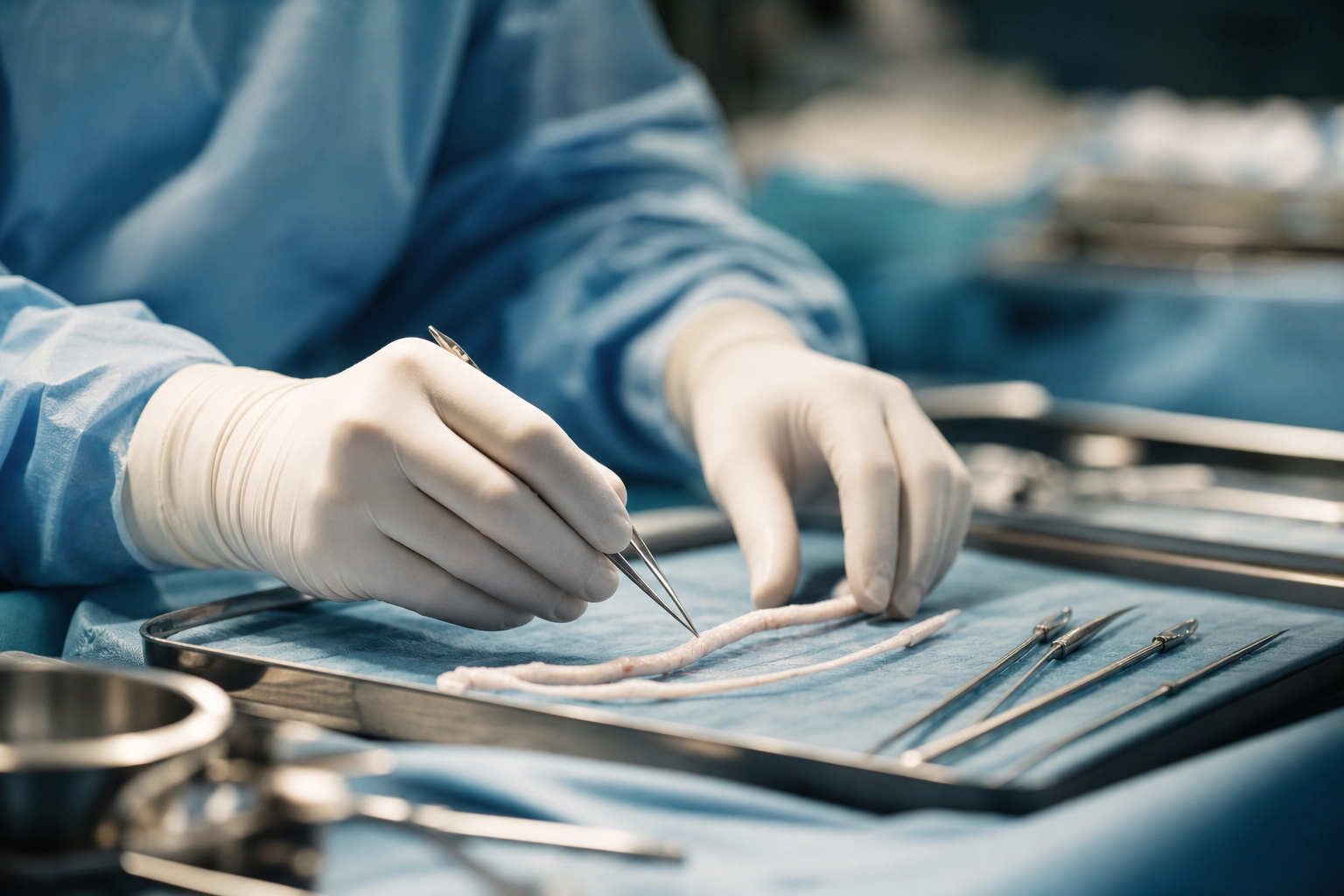
In the classic open method, a long incision follows the vein. Many patients remember it as “half my leg was stitched.” In endoscopic vein harvesting (EVH), a small entry near the knee or thigh and a few short cuts are usually enough; the vein is prepared under the skin.
I hear this sentence often: “I can face the heart surgery — it’s the leg scar that bothers me.” That worry is not vanity. Wound infection, delayed healing, pain, and cosmetic result are heavier with open harvest. A systematic review in the Journal of Cardiothoracic Surgery found that EVH can meaningfully reduce leg wound infections and edema versus open harvest. Older randomized trials also report lower infection risk, less pain, and higher patient satisfaction (J Thorac Cardiovasc Surg, 2002).
The ISMICS consensus on endoscopic conduit harvest supports endoscopic saphenous (and, when suitable, radial) harvest to cut wound complications, raise satisfaction, and ease wound-care burden — as a reasonable standard-of-care direction. So this is not only about a nicer scar; it is also about fewer wound problems and, for many patients, easier early walking. Multicentre follow-up has also reported lower leg wound infection rates with EVH (PMC review).
I also set a clear limit: not every anatomy or centre is the same. Vein quality, prior leg surgery, urgency, or technical fit may still require an open harvest. Older papers raised questions about graft trauma and patency; experience and careful technique matter. Current consensus and large reviews emphasize EVH’s wound advantage while treating major clinical outcomes as comparable when EVH is done well. “No scar” does not mean “the graft does not matter” — the heart-side plan stays first.
In practice I like this clarity for patients: if a leg vein is needed, endoscopic harvest in centres that offer it softens the fear of a long cut. Small incisions still need wound care — but a “full-leg scar” is no longer the default expectation for many people.
When does the arm (radial) artery come into play?
Short answer: In selected patients as a second arterial graft — when hand circulation is safe.
The radial artery can offer better long-term patency than a vein graft in the right setting. It is not for every arm. The hand needs a solid alternative blood supply (ulnar flow). That is why Allen testing or similar checks are done. Heavy hand-labor jobs, prior radial procedures, or circulation concerns push the plan toward other conduits.
Guideline updates note that in suitable patients the radial artery may be preferred over vein for the second most important target. That is not “radial for everyone.” Suitability comes first.
Are artificial grafts used?
Short answer: Not as a routine choice in coronary bypass; your own vessel is preferred.
Synthetic grafts are common in some peripheral artery operations. For thin coronary targets, teams usually look first for an autologous (your own) conduit. Rare special situations exist; this piece is about everyday CABG practice.
Who decides which graft is used?
Short answer: The surgeon and heart team, using the angiogram, other illnesses, and the operative plan.
If you say “I don’t want my leg touched,” that preference is heard — but it should not force an unsafe or fragile plan. Sometimes one LIMA is enough for the key target; sometimes three or four bridges are needed. Sometimes the radial is an excellent candidate; sometimes hand flow is not reassuring.
Useful questions in clinic:
- Which coronaries will be grafted?
- Will LIMA be used?
- Will a leg or arm graft be needed?
- If saphenous vein is used, endoscopic or open harvest?
- What should I expect at the harvest site?
- Am I a candidate for arterial grafts?
Asking is participation, not distrust.
Graft choice is only half the story
Even a perfect bridge sits on the same disease soil. Smoking, cholesterol, blood pressure, and diabetes still shape graft life. Stopping medicines because “I had surgery, so I’m done” is a quiet way to undermine the bridge.
For the broader arterial picture, see arterial diseases.
Short answers to worries I hear often
“Will a leg vein cause varicose veins?”
No — harvest removes that segment; it does not create varicose disease. Swelling can still happen.
“Is a long leg scar inevitable?”
Not always. With suitable endoscopic vein harvesting, cuts are usually much shorter; literature often reports fewer wound complications and better cosmetic satisfaction.
“Will taking the chest artery collapse my chest?”
No. LIMA sits beside the sternum; fixation protects the chest wall. Sternum healing is a separate recovery topic.
“One vessel or everything?”
As many as needed for durable blood supply — not maximum harvest.
A practical takeaway
Bypass grafts are usually your own chest, arm, or leg vessels. LIMA is strong long-term when suitable; saphenous vein still matters for multiple bridges; radial helps in selected cases. The point is matching the plan to your anatomy, not memorizing names.
To review your angiogram and graft options together, you can request an appointment from the contact page. For background on my approach, see About Dr. Kadir Çeviker.
Frequently asked questions
Where is the vessel taken from in bypass surgery?
Short answer: Most often the chest (LIMA), the leg (saphenous vein), and in selected patients the arm (radial).
Combinations vary; there is no single standard address.
Which graft is best?
Short answer: There is no one “best for everyone.” Suitable arterial grafts often have long-term advantages.
LIMA is frequently preferred; radial helps in selected patients; saphenous vein is still a common and necessary tool.
Does the harvest site stop working?
Short answer: No. Alternative pathways usually keep the arm or leg functioning.
Early swelling and tenderness are common; lasting serious harm is not the expected outcome, but warning signs should be reported.
Is endoscopic vein harvesting for everyone?
Short answer: It is the goal for many suitable patients; anatomy, urgency, or technique may still require open harvest.
Fitness for EVH is a team decision — scar anxiety alone should not drive the graft plan.
Key references
- 2021 ACC/AHA/SCAI Guideline for Coronary Artery Revascularization
- American Heart Association. What Is Coronary Artery Bypass Surgery? — CABG overview PDF
- Endoscopic versus open vein harvesting for CABG — systematic review (J Cardiothorac Surg, 2025)
- ISMICS consensus: endoscopic conduit harvest
- Randomized trial: endoscopic vs conventional saphenous harvest (JTCVS, 2002)
- Multicentre review: EVH vs OVH long-term outcomes (PMC)