

What CEAP Stage Are Your Varicose Veins? A Simple Clinic Guide
One of the lines I hear most in clinic is: “Doctor… I have veins in my leg. What stage is this? Is it bad?”
Sometimes it is spider veins. Sometimes bulky varicosities. Sometimes swelling. Sometimes dark skin around the ankle. People call all of that “varicose veins,” yet the clinical weight is not the same. Doctors use an international framework—CEAP—so the same finding is written in the same language. Here I open the part you see: clinical class C0 to C6, in everyday words.
Note: This article is general information. You cannot lock a stage from a photo alone. Examination and venous Doppler still matter.
For the wider picture see varicose veins and chronic venous insufficiency.
What does CEAP mean—four letters, four jobs?
Short answer: Clinical, Etiologic, Anatomic, and Pathophysiologic. It describes the venous picture in a shared language.
In plain clinic talk:
- Clinical: What you see or feel on exam
- Etiologic: Why—primary, secondary (for example after old clot), or congenital
- Anatomic: Superficial, deep, or perforating veins
- Pathophysiologic: Reflux, obstruction, or both
The framework grew from American Venous Forum work in the 1990s, was revised in 2004, and updated in 2020. The European Society for Vascular Surgery 2022 guideline also discusses chronic venous disease in this language. Sources are at the end.
In day-to-day notes we often write the clinical class (C0–C6) first. A full CEAP entry adds cause, location, and mechanism beside it. Your question is usually simpler: “Which C am I?”
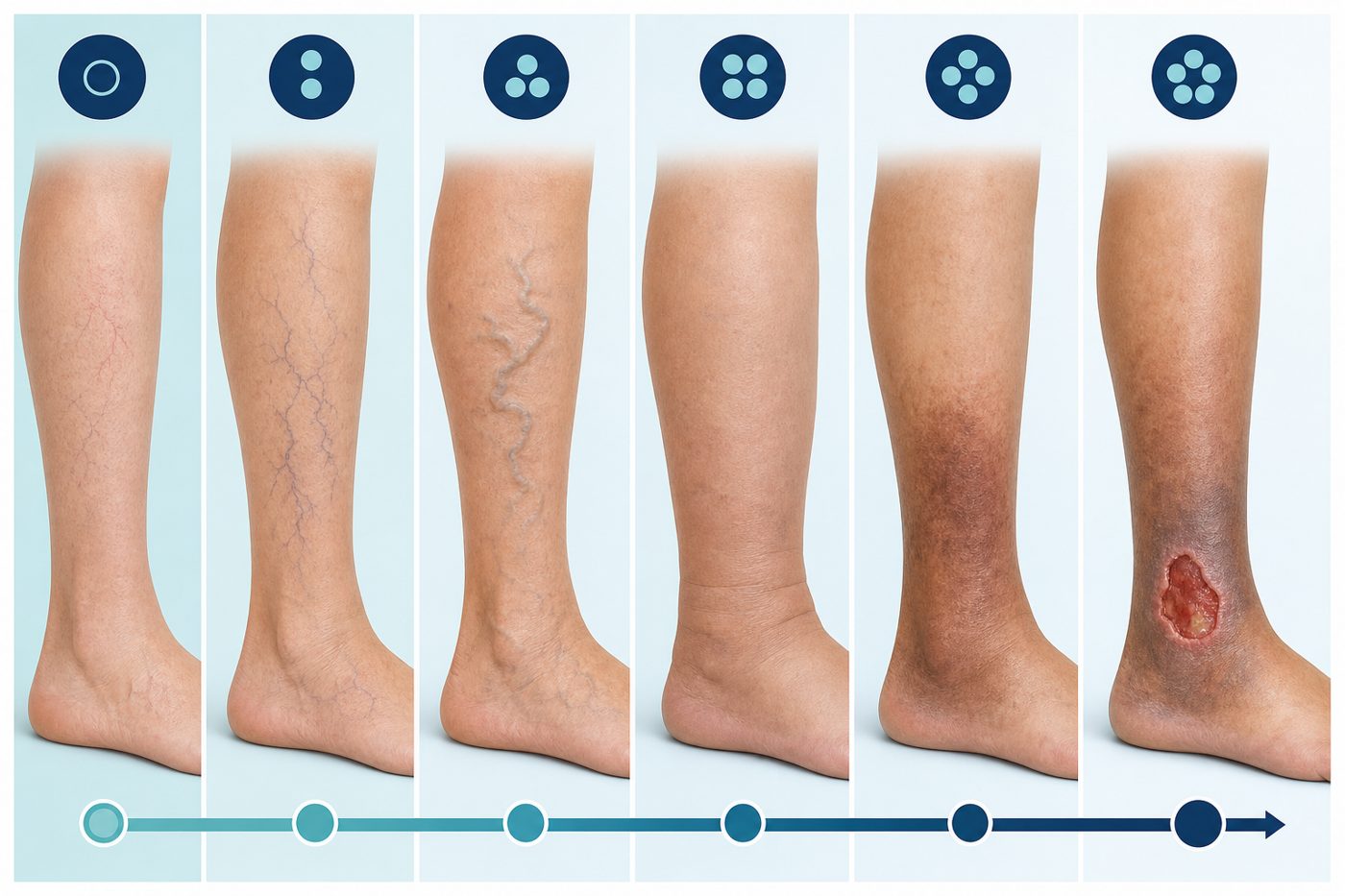
Clinical classes: C0 to C6—what stage are you in?
For one leg we usually report the highest (most advanced) class. A detailed record can list more than one class on the same leg. Symptom status (symptomatic / asymptomatic) can be noted separately. The summary below follows the 2020 CEAP update.
C0 — No visible vein signs
No varicose or spider veins you can see; no clear cord you feel. You may still have heaviness, evening “puffiness,” or fatigue. That does not mean “nothing inside.” Doppler may still be needed.
C1 — Spider veins / fine networks
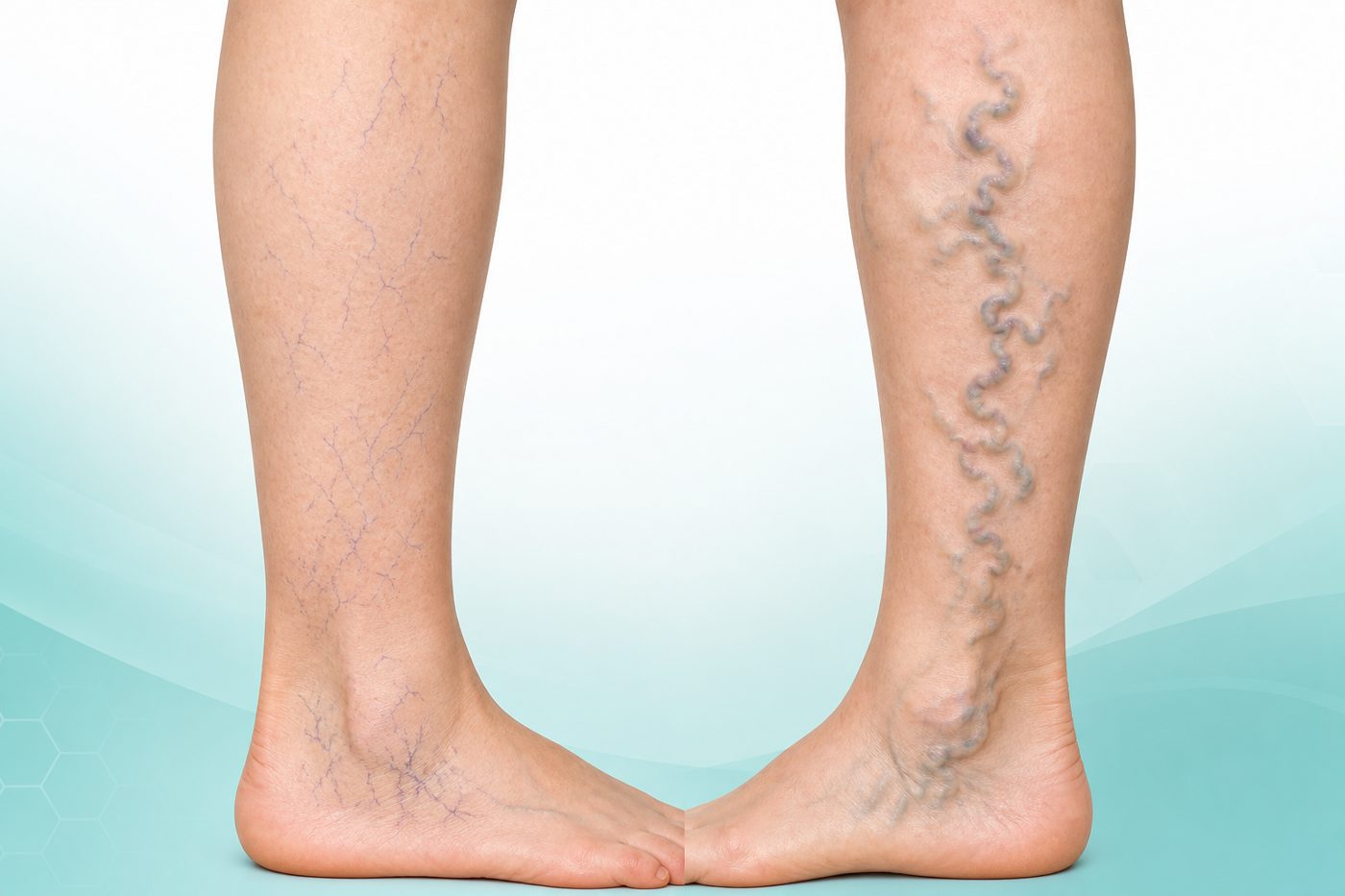
Telangiectasias or fine blue-green networks under the skin (reticular veins). Many patients call this “spider varicose veins.” Cosmetic worry is common; reflux underneath can still be there. Foam sclerotherapy comes up often in this group.
C2 — Frank varicose veins
Usually 3 mm or larger, bulging, tortuous veins. Pain, heaviness, itch, or night cramps may travel with them. Recurrent varicosities after treatment can be marked C2r. If great saphenous reflux is present, laser treatment for varicose veins often enters the conversation.
C3 — Edema (swelling)
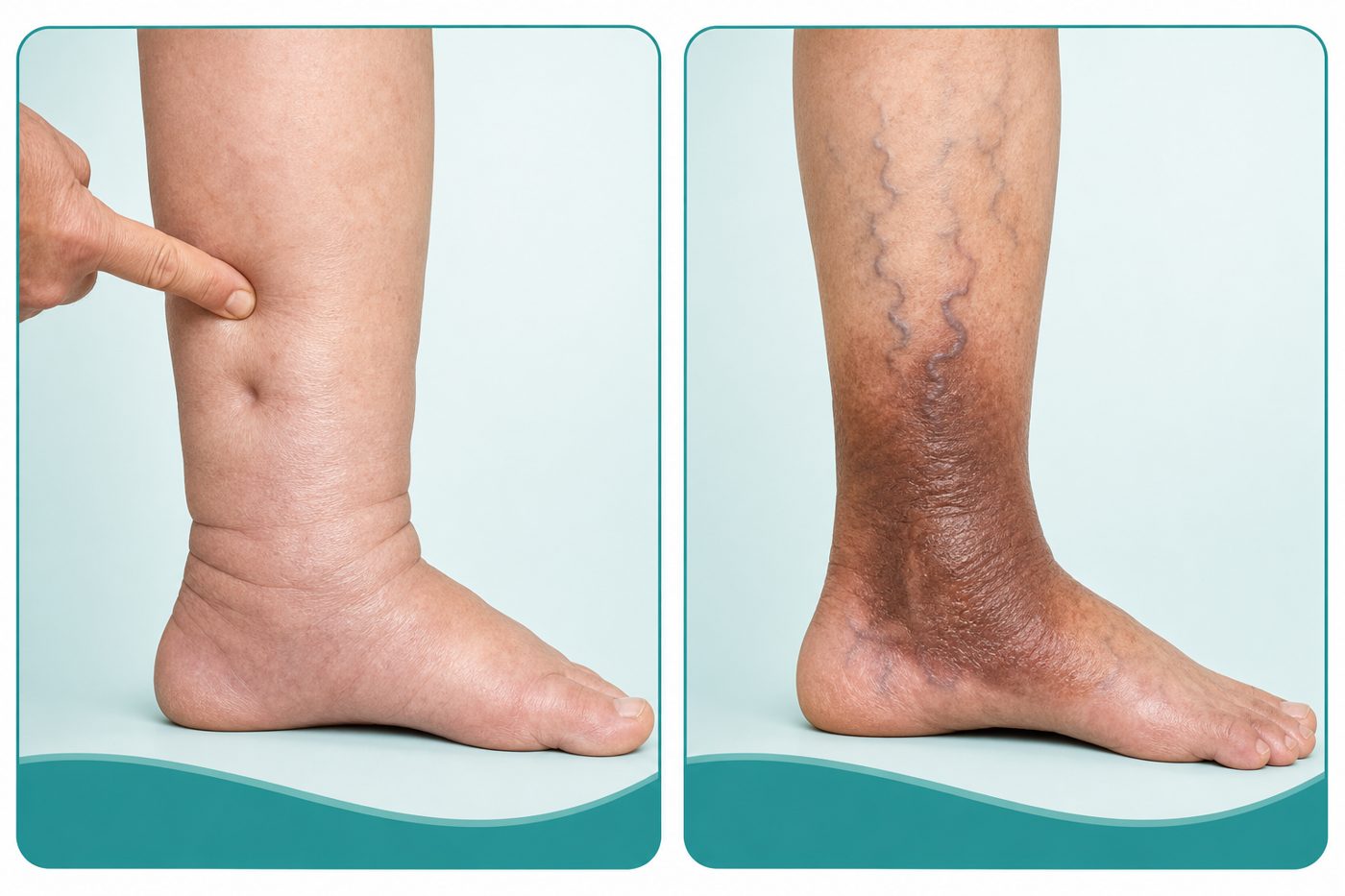
Swelling tied to venous pressure. It often worsens by evening and eases overnight. Here compression and clarifying the cause (reflux versus something else) matter. Compression stockings are frequently discussed; class and fit belong to the clinician.
C4 — Skin and soft-tissue changes
Skin findings from venous disease. The 2020 update split them more clearly:
- C4a — Pigmentation or eczema
- C4b — Lipodermatosclerosis or atrophie blanche
- C4c — Corona phlebectatica (fan of small veins around the ankle)
I say this plainly: do not dismiss C4 as “just a stain.” Pressure has been stressing tissue for a long time; ulcer risk is higher.
C5 — Healed venous ulcer
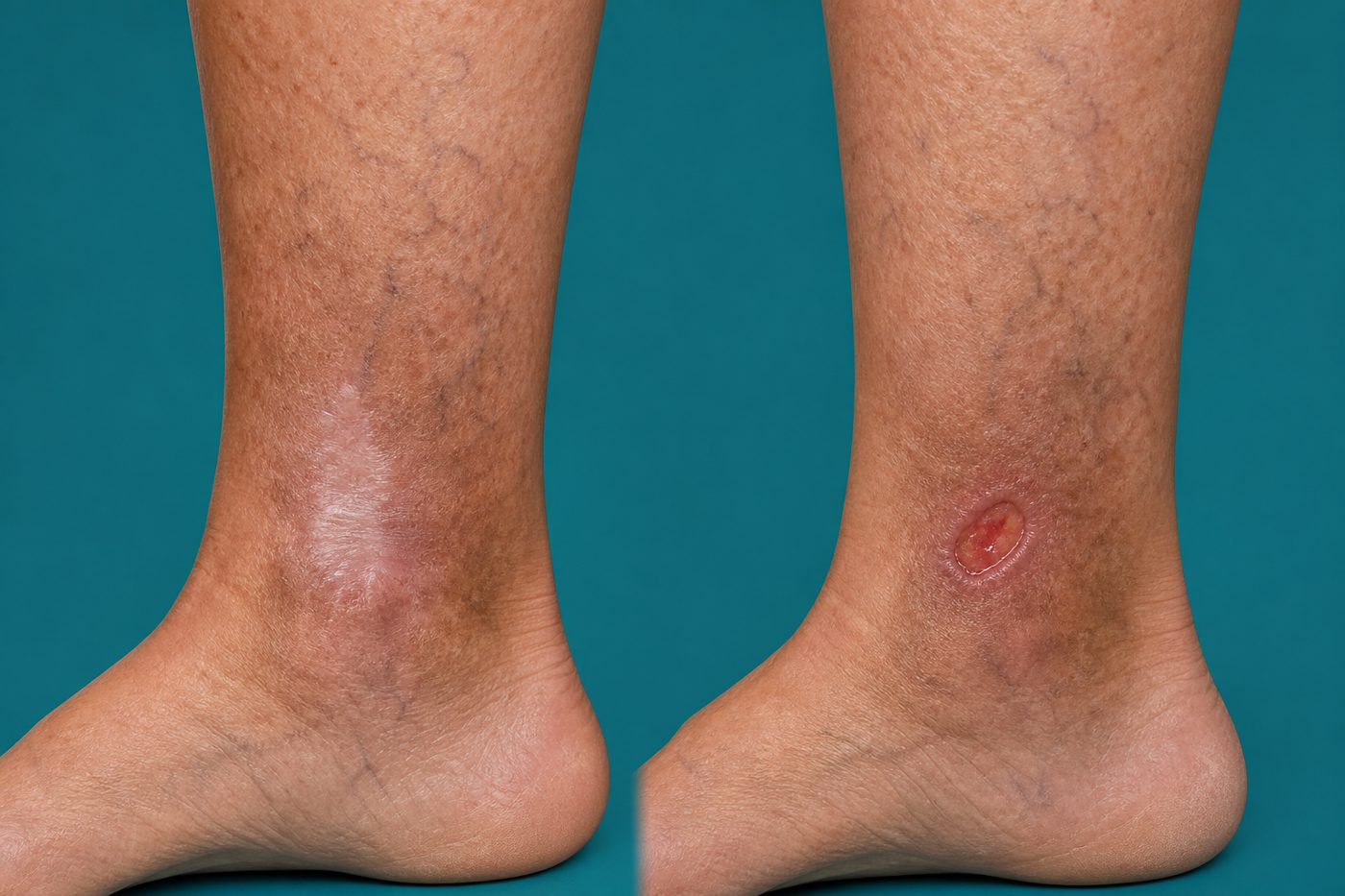
An open wound closed before; a scar remains. “Done” is the wrong word—recurrence risk stays. The venous ulcer page covers that chapter in more detail.
C6 — Active (open) venous ulcer
Usually an open, slow-to-heal wound near the inner ankle. This is the most advanced clinical class. Recurrent active ulcer can be marked C6r. Do not wait; dressings alone rarely fix the underlying venous leak.
Can I find my stage from a photo alone?
Short answer: No. A photo gives a hint. The class is set with exam plus venous Doppler.
CEAP gives a shared language; it does not pick the treatment by itself. One C2 patient may be quiet; another may be sore every evening. Deep veins, perforators, or pelvic reflux do not announce themselves in a selfie. So the honest answer to “what stage are you?” is: we look first, map with ultrasound, then talk.
For treatment pathways see varicose veins.
How does the visit usually go?
- History and exam (what you see)
- Venous Doppler (reflux / obstruction / location)
- CEAP record (clinical class, and fuller components when useful)
- Compression, lifestyle, procedure, or wound care—matched to the picture
In C1–C2, looks and symptoms often travel together. From C3 onward, “cosmetic only” gets harder to say. In C5–C6 the priority is the wound and controlling the leak.
One more plain line: a higher class does not mean “an ulcer opens tomorrow.” Still, when a leg is approaching or already in C4, I do not like wasting time.
When should you come sooner?
Short answer: Rapidly enlarging veins, sudden swelling, redness with pain, a wound that will not close, or an old ulcer scar that opens again.
Asymmetric swelling or sudden painful swelling also make us think beyond varicose staging (for example clot). CEAP is a language for venous disease; it does not explain every leg complaint alone.
Another everyday myth: “I wear stockings, so I do not need Doppler.” Compression helps; it does not map the leak underneath.
You can request an appointment via the contact page.
Frequently Asked Questions
What is CEAP?
An international venous classification that records clinical findings, cause, anatomy, and mechanism together. The 2020 update is still the clinic reference.
Can I tell which C I am myself?
You can form a rough idea (spider veins, bulging veins, swelling, skin change, ulcer). A firm class needs exam and Doppler. One phone photo is not a final stage.
What do C2r and C6r mean?
Notes added in 2020 for recurrent varicose veins (C2r) and recurrent active ulcer (C6r). It is follow-up language, not “I was treated, so it is finished forever.”
What is the difference between C4a, C4b, and C4c?
All are skin/soft-tissue change: a is pigmentation/eczema, b is hardening/atrophie blanche, c is the ankle fan of small veins. None of them is “just a stain.”
Does CEAP choose the treatment?
No. It organizes the shared record. One C2 patient may watch and wait; another may need a procedure—symptoms, the Doppler map, and expectations are discussed together.
Scientific Sources
- Lurie F, et al. The 2020 update of the CEAP classification system and reporting standards. J Vasc Surg Venous Lymphat Disord. 2020 — DOI: 10.1016/j.jvsv.2019.12.075 · PubMed 32113854
- De Maeseneer MG, et al. European Society for Vascular Surgery 2022 clinical practice guidelines on chronic venous disease. — DOI: 10.1016/j.ejvs.2021.12.024
- StatPearls / NCBI. CEAP Classification of Venous Disorders