

Exosomes and Peripheral Artery Disease: What Breaks in the Vessel?
In clinic I often hear this: “After a few hundred metres my calf tightens, then it eases when I stop. My feet are cold. Someone mentioned ‘exosomes’ — would that help my leg?”
We can talk about both in one visit. First we need to name what is broken. With exosomes and peripheral artery disease, the real question is the pathology and which parts of that chain the science is studying.
Disclaimer: This is general education. Diagnosis, treatment, and any product choice are individual. Exosome research is not the same as routine clinical care.
For symptoms and standard care, see leg artery blockage. For what exosomes are and are not, see what exosomes are and are not.
What actually happens in peripheral artery disease?
Short answer: Plaque narrows or blocks arteries in the legs (sometimes arms); muscle and skin get less oxygen.
What patients feel is often a “cramp-like” calf pain. Walking raises the muscle’s oxygen demand; a narrowed artery cannot meet it. Rest eases the pain — intermittent claudication. If disease advances, night pain, coldness, colour change, and non-healing wounds can follow. For the advanced picture, see critical limb ischemia and wound care.
So PAD is not only a “blocked pipe.” Plaque, the vessel lining (endothelium), chronic inflammation, oxidative stress, and microcirculation fail together. That is why the plan cannot be reduced to a single injection.
How does endothelial injury start the chain?
Short answer: Endothelium is the vessel’s smart inner lining; when it fails, the artery cannot relax well and plaque and clot find easier ground.
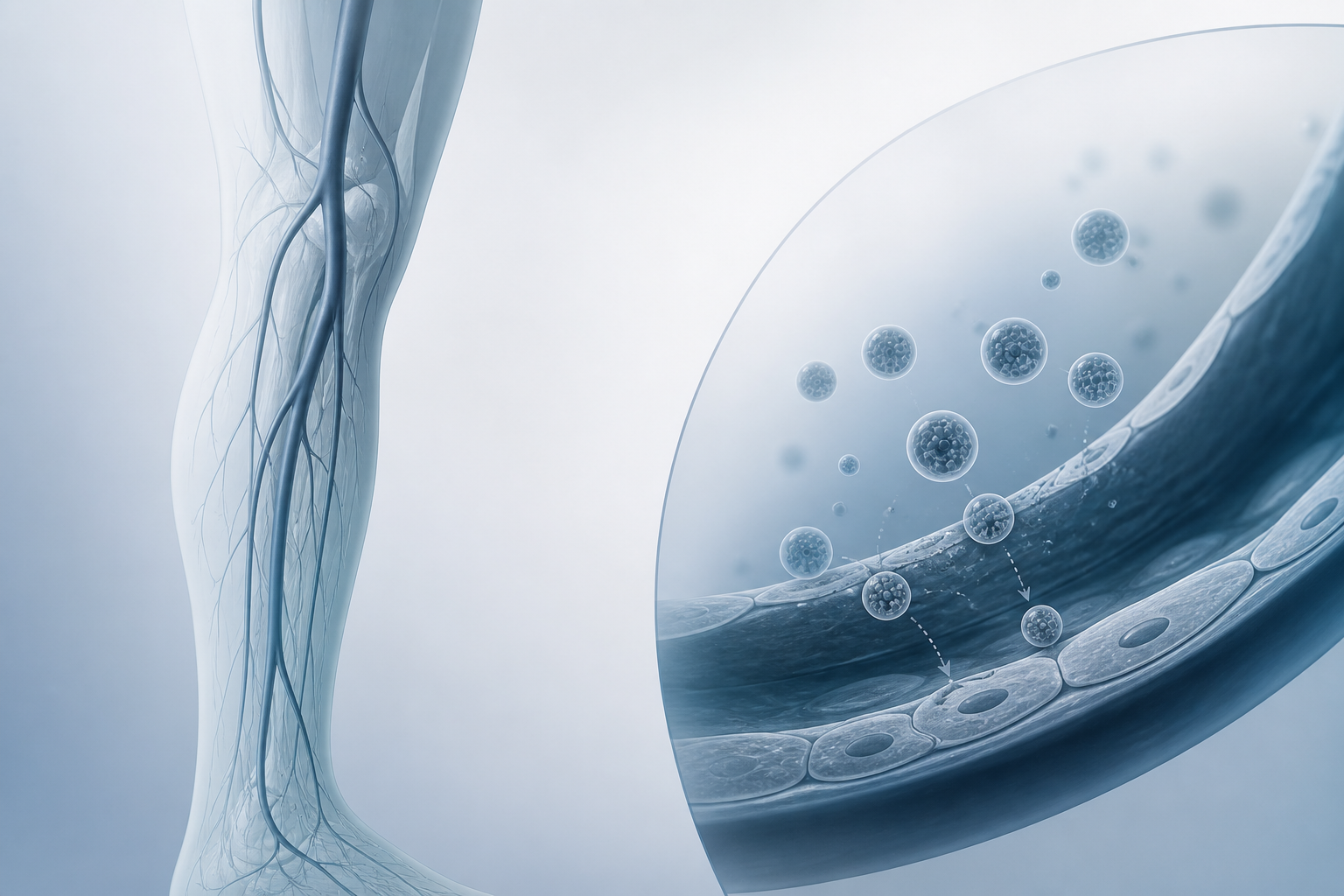
Healthy endothelium keeps vessels open with signals such as nitric oxide, balances clotting, and limits inflammatory cells sticking to the wall. Smoking, diabetes, high cholesterol, and hypertension disturb that balance. Endothelial injury is an early step in atherosclerosis. Extracellular vesicles (exosomes belong in this family) are studied both as message carriers and sometimes as biomarkers: stressed cells can spread inflammation and endothelial dysfunction through the vesicles they release.
What changes with inflammation in the vessel wall?
Short answer: A chronic, low-grade inflammatory state keeps the wall on “continuous alert”; plaque grows and can become unstable.
Macrophages, platelets, and smooth muscle cells keep talking. Lipid enters the plaque, a necrotic core may form, the wall stiffens. Walking capacity falls; in advanced ischemia, tissue loss risk rises. Literature shows extracellular vesicles in atherosclerosis and PAD can carry inflammatory signals — and that vesicles from certain sources can also carry anti-inflammatory cues. Putting “exosome = good” in one box is not science; source and cargo decide.
Why do collaterals and microcirculation fall short?
Short answer: Even when a large artery narrows, the body tries to open side routes (collaterals); in PAD that response is often not enough.
In ischemic tissue, new capillary formation (angiogenesis) and small-vessel function may already be impaired. Muscle fatigues; if there is a wound, lack of oxygen and nutrients delays healing. That is why arterial foot ulcers are not solved by dressings alone: the first question is whether blood reaches the tissue.
Where does exosome research look in this chain?
Short answer: Mainly endothelial repair, angiogenesis, softening of inflammation, and repair signals in ischemic tissue — mostly preclinical and early clinical work.
Exosomes / extracellular vesicles are tiny membrane packages carrying proteins, lipids, and microRNAs. Vesicles from mesenchymal stromal cells or endothelial progenitors have been reported, in experimental models, to support new vessel formation, stimulate endothelial proliferation and migration, and dampen some inflammatory pathways. In critical limb ischemia, cell-derived vesicles and artificial nanovesicles are reviewed as research paths beside or beyond conventional revascularization.
Science is not hunting a spell that instantly “opens” the main artery. It asks: in oxygen-starved tissue, which messages between cells could strengthen repair and collateral response? Exosomes are a candidate for those message packages.
For the broader frame, see exosome therapy overview and what regenerative medicine is.
Do exosomes open a blocked artery like a stent?
Short answer: No. An exosome is not a “clog opener” that replaces angioplasty or bypass.
This matters clinically. For a plaque-narrowed femoral or popliteal artery, standard care is risk-factor control, medicines, exercise, and when needed interventional or surgical revascularization. What exosome research hopes to touch is more the microcirculation–inflammation–tissue repair axis — and there is not yet a proven, one-size, routine “PAD exosome protocol” for every patient. Source, manufacturing, characterization, and safety also differ between products; I unpacked that in what exosomes are and are not.
What should come first in clinic?
Short answer: Tobacco, diabetes, blood pressure, cholesterol first; then how bad the circulation is; if there is a wound, why; supportive methods last.
In clinic the order is: pulses, walking distance, rest pain, wound or not? Then Doppler, ankle–brachial index, angiography when needed. If arterial supply is critically low, dressings or a biologic alone will not fix it. Regenerative approaches only make sense on the right foundation — beside established care, not instead of it. See arterial disease for the overall map.
Separating hope from evidence is part of patient safety. Research can be exciting; the decision for your leg still rests on examination and imaging.
For calf pain on walking, cold feet, or a wound that will not close, you can request an appointment on the contact page.
Frequently Asked Questions
Do exosomes cure peripheral artery disease?
Short answer: Saying they “cure” it on their own is not accurate; there is a promising research field, not a routine guarantee.
Cell source, dose, delivery route, and patient selection change outcomes. Clinical translation is still early.
Which PAD problems are exosomes studied for?
Short answer: Endothelial function, angiogenesis, inflammation, and ischemic tissue repair.
The aim is not mechanically opening the large artery, but supporting intercellular repair signals.
What should I do if my calf hurts when I walk?
Short answer: Do not dismiss it as “just age”; you need a vascular assessment.
Stop smoking if you smoke; control risk factors; plan imaging when indicated.
Are exosomes first-line for a non-healing foot wound?
Short answer: No. Circulation, infection, pressure, and diabetes come first.
If arterial supply is inadequate, delaying revascularization for surface-only treatments can cost time.
Scientific references
- Emerging role of exosomes in vascular diseases (Frontiers in Cardiovascular Medicine, 2023)
- Extracellular vesicles in atherosclerosis cardiovascular disease (Frontiers in Cardiovascular Medicine, 2025)
- Cell-derived EVs and artificial nanovesicles in critical limb ischemia (Bioengineering, 2025)
- Extracellular vesicles in cardiovascular diseases (PMC)
- Extracellular vesicles as biomarkers for vascular disease (Biomolecules, 2026)
- MISEV2023 — minimal information for extracellular vesicle studies (ISEV)