

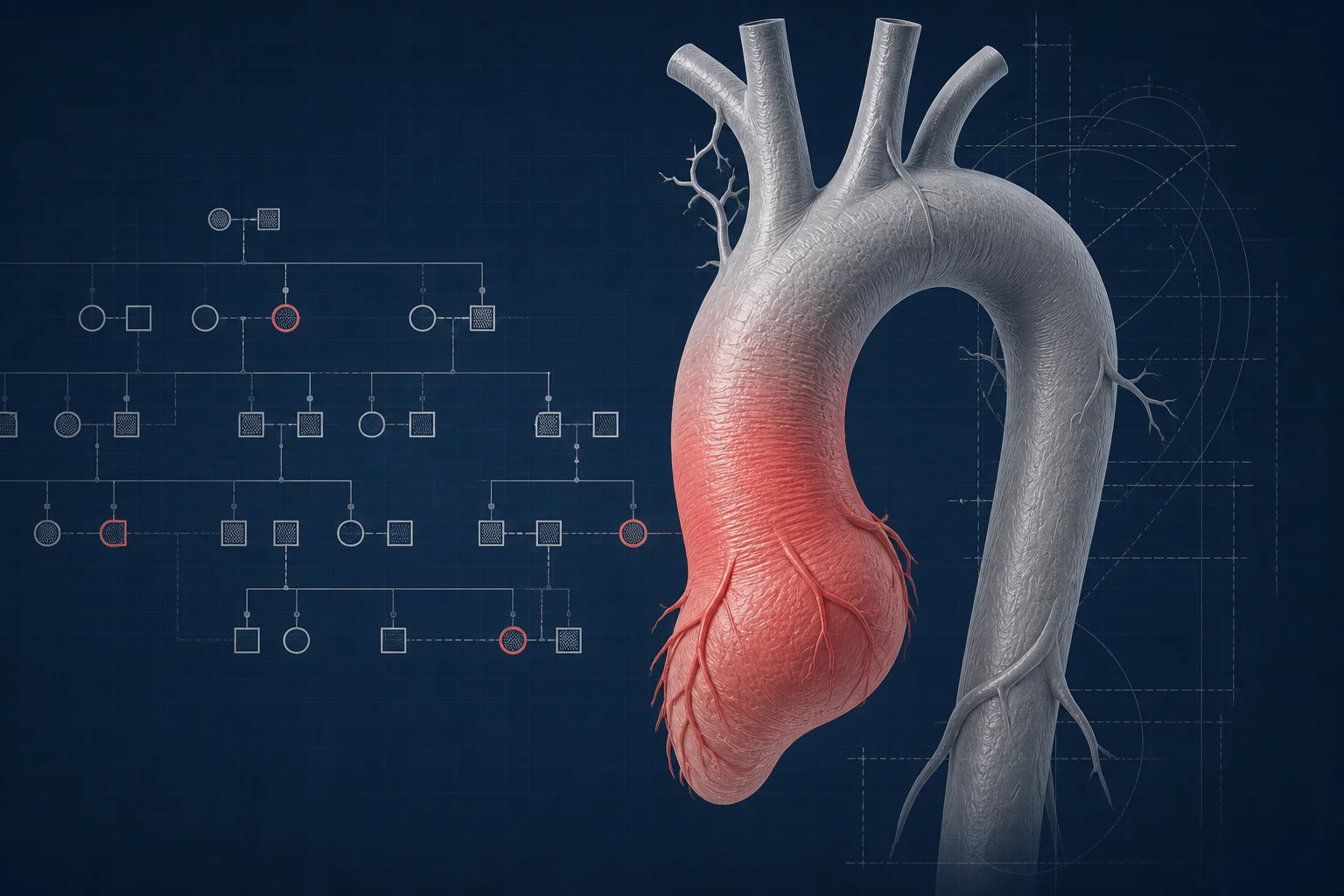
The aorta is the body’s largest artery. It can enlarge quietly for years without causing symptoms. If a family includes an aortic aneurysm or dissection, asking “Could I have it too?” is more than curiosity. Some aortic conditions have a genetic basis, and imaging relatives can identify risk before an emergency occurs.
Heritable aortopathy describes genetic conditions that affect the structure and strength of the aortic wall. Genetic testing may do more than name the diagnosis: in selected genes, it can influence surveillance and the timing of preventive surgery.
Can an aortic aneurysm run in families?
Not every aneurysm is inherited. Age, hypertension, smoking, and atherosclerosis remain important. Heritable thoracic aortic disease becomes more likely with an aortic-root or ascending-aortic aneurysm, dissection at a young age, similar events in relatives, or connective-tissue features.
Marfan syndrome, Loeys-Dietz syndrome, and vascular Ehlers-Danlos syndrome are syndromic examples. Families with variants in genes such as ACTA2, MYH11, MYLK, or PRKG1 may have no obvious outward syndrome.
Who should consider genetic evaluation?
The 2022 ACC/AHA Aortic Disease Guideline recommends genetic testing for people with aortic-root/ascending-aortic aneurysm or dissection who have risk factors for heritable thoracic aortic disease. Clues include:
- Thoracic aortic disease presenting before age 60
- A first- or second-degree relative with thoracic aortic disease or unexplained sudden death at a young age
- Physical features suggestive of Marfan, Loeys-Dietz, or vascular Ehlers-Danlos syndrome
- A family history of intracranial or peripheral-artery aneurysm
Record more than “heart disease” in the pedigree. The location of the aneurysm, age at dissection or surgery, and—if known—the aortic diameter are valuable.
If genetic testing is negative, does family screening stop?
No. Not every genetic cause of thoracic aortic disease is currently known. First-degree relatives of a person with aortic-root/ascending-aortic aneurysm or dissection may therefore be offered aortic imaging even when genetic testing is negative.
Echocardiography is often the first study. CT or MRI may be used if the aortic root and ascending aorta are not adequately seen. The interval between scans depends on the initial findings, family history, and the gene involved.
What does a positive result mean for relatives?
If a pathogenic or likely pathogenic variant is identified, at-risk biological relatives can have targeted testing for the same change. Carriers receive aortic imaging and gene-informed surveillance. Non-carriers may avoid unnecessary follow-up when no other familial risk is present.
A variant of uncertain significance must not be used to decide who is at risk or who needs surgery. See our guide to cardiovascular genetic test interpretation.
Can genetic information change the timing of surgery?
Yes. This is one area where genetics can contribute directly to surgical planning. A single diameter threshold used for sporadic aneurysm should not be applied to every inherited condition. Dissection can occur at smaller diameters with some genes, so preventive surgery may be considered earlier.
There is no equation that says “gene found, operate now.” The exact gene and variant, aortic diameter and growth rate, the diameter at which relatives dissected, pregnancy plans, body size, valve anatomy, and operative risk are considered together by an experienced multidisciplinary aortic team.
Which symptoms are an emergency?
Sudden severe chest or back pain, fainting, shortness of breath, new speech difficulty, or weakness on one side may signal aortic dissection. Do not wait for a clinic appointment; call emergency services.
What should you bring to a family assessment?
- Aortic imaging reports and, if possible, the actual images
- Ages at aneurysm diagnosis, dissection, sudden death, and aortic surgery in relatives
- Available operative and pathology reports
- The complete report from any previous genetic test
For broader information about vascular disease, you can also visit our page on arterial diseases.
Takeaway
Heritable aortopathy may have visible syndromic clues—or none at all. Combining family history, appropriate imaging, and genetic testing that starts with the right person can improve care for both the patient and relatives who have not yet developed symptoms.
If your family includes an aortic aneurysm, dissection, or unexplained sudden death at a young age, visit our page on cardiovascular genetic evaluation or request an appointment.
Frequently asked questions
If an aortic aneurysm runs in my family, will I definitely have one?
No. Risk depends on the underlying condition and inheritance pattern. Baseline aortic imaging is still important for first-degree relatives.
If the genetic test is negative, can I skip imaging?
Not necessarily. Relatives may still need imaging when familial aortic disease is present but no causative gene has been found.
Is there one diameter at which everyone needs surgery?
No. Thresholds are individualized according to aortic segment, growth, body size, valve anatomy, family history, and the responsible gene when known.
Scientific sources: 2022 ACC/AHA Aortic Disease Guideline; 2024 ESC Peripheral Arterial and Aortic Diseases Guideline; Review of heritable aortic-root aneurysms.
This article is for general education. Aortic thresholds and surgical timing require individual clinical assessment. Call emergency services for acute symptoms.