


Rapamycin longevity in one line: the molecule (sirolimus) turns down a metabolic growth path — mTOR — and autophagy, the cell’s cleanup shift, gets more time. Forums call it a lifespan pill. Mice live longer. In humans it is not an approved aging drug.
Ross Pelton’s 2022 review (Rapamycin: Extending Health Span and Life Span) uses that hook: healthspan plus the mTOR/autophagy seesaw. The mechanism holds. “Most effective life-extension drug ever, almost everyone should take 5–6 mg a week” is a different register. I am not importing it.
Note: Science explainer. Not a prescription or a home protocol.
The other layers of cellular aging (including nutrient sensing) are in hallmarks of aging. Rapamycin sits on that metabolic knob.
Where did rapamycin come from?
In 1964–65 a team sampled soil on Easter Island (Rapa Nui). In the 1970s Streptomyces hygroscopicus (later also S. rapamycinicus) came out of those samples; the island named the molecule. It was tried as an antifungal, parked when it suppressed immunity, then approved in 1999 as Rapamune to help prevent kidney-transplant rejection. That is Pelton’s timeline (PMC9173851).
Millions of transplant-years do not mean “safe longevity pill.” Daily immunosuppression and a low weekly dose are not the same sentence.
What is mTOR — an accelerator?
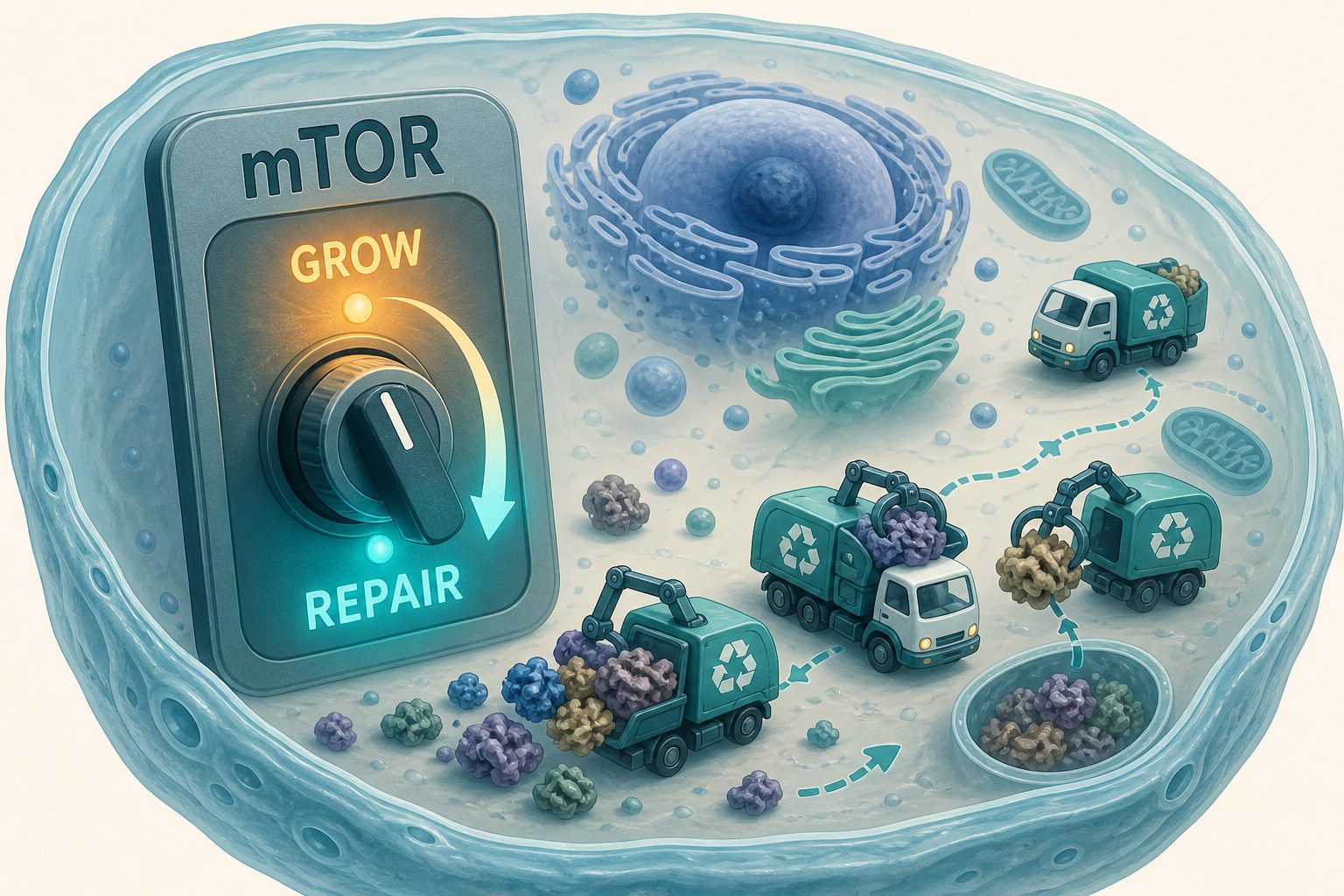
mTOR, mechanistic target of rapamycin: “make protein, grow, divide.” Food on: construction. Scarcity: repair. Rapamycin mainly turns down mTORC1 — the name is the target.
Children and healing wounds need that pedal. In midlife, stuck to the floor, the cell stays in build mode. Pelton calls the modern version “mTOR syndrome”: fridge plus snacking, growth signals all day, no shift left for autophagy. Not a billing code. A usable picture. Our ancestors did not open a refrigerator every morning. We can spend sixteen hours in a digestion marathon.
A 2025 review says the same hub: overactive mTOR may speed the terrain of age-related disease; damping it lengthens life in animals (Frontiers in Aging).
Autophagy: who takes out the trash?
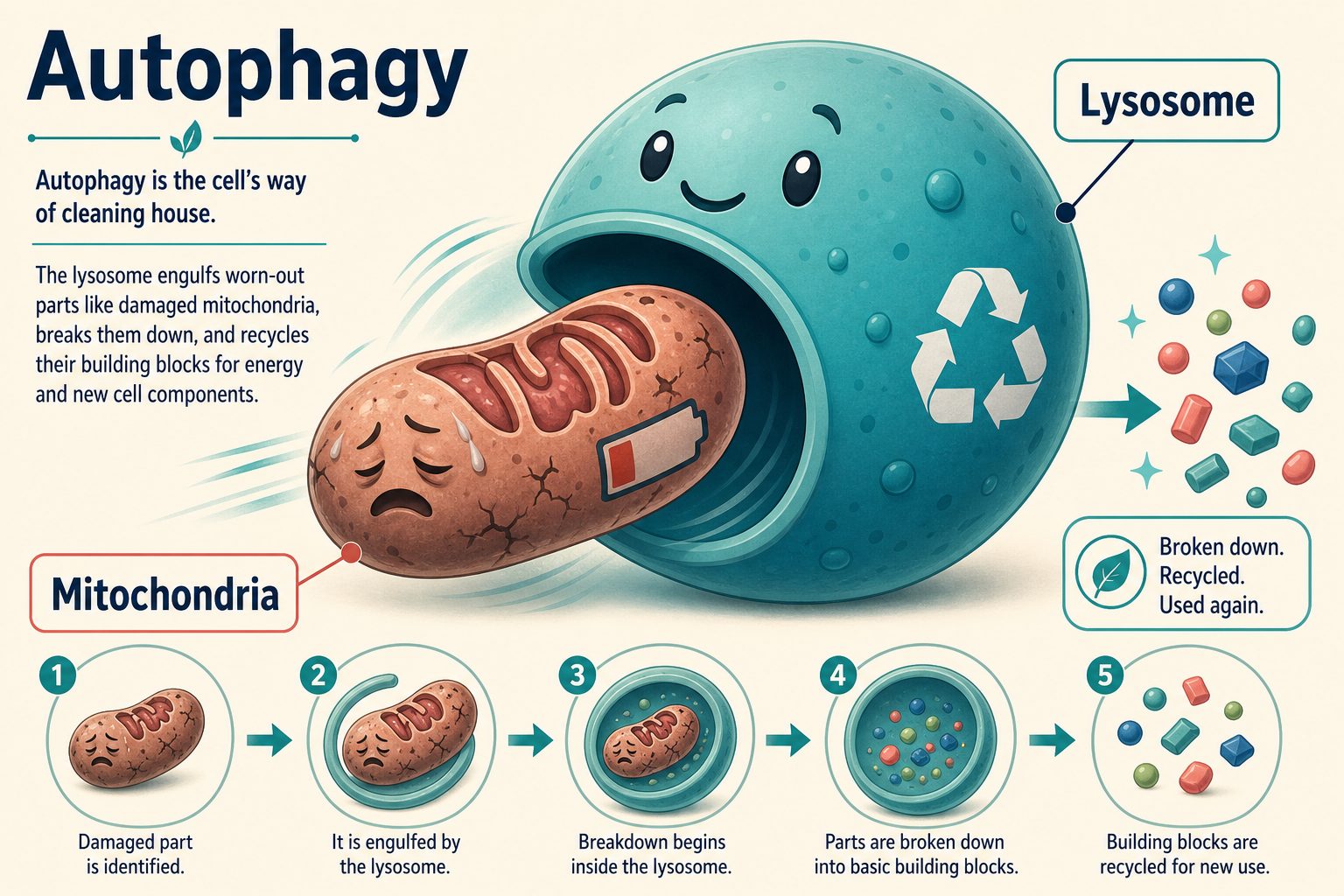
Greek for “self-eating.” Sounds grim; it is housework. Yoshinori Ohsumi won the 2016 Nobel for the mechanism. Worn mitochondria, misfolded proteins, junk go to the lysosome. When mTOR is high, autophagy stays low — a seesaw.
Think of mitochondria as batteries. An old one gives less power and leaks. Autophagy (mitophagy) sorts those batteries. Pelton reads longevity from here: partial mTOR brake, a longer cleanup shift. Not magic. Cellular maintenance.
What did mice show — where does the human ladder break?
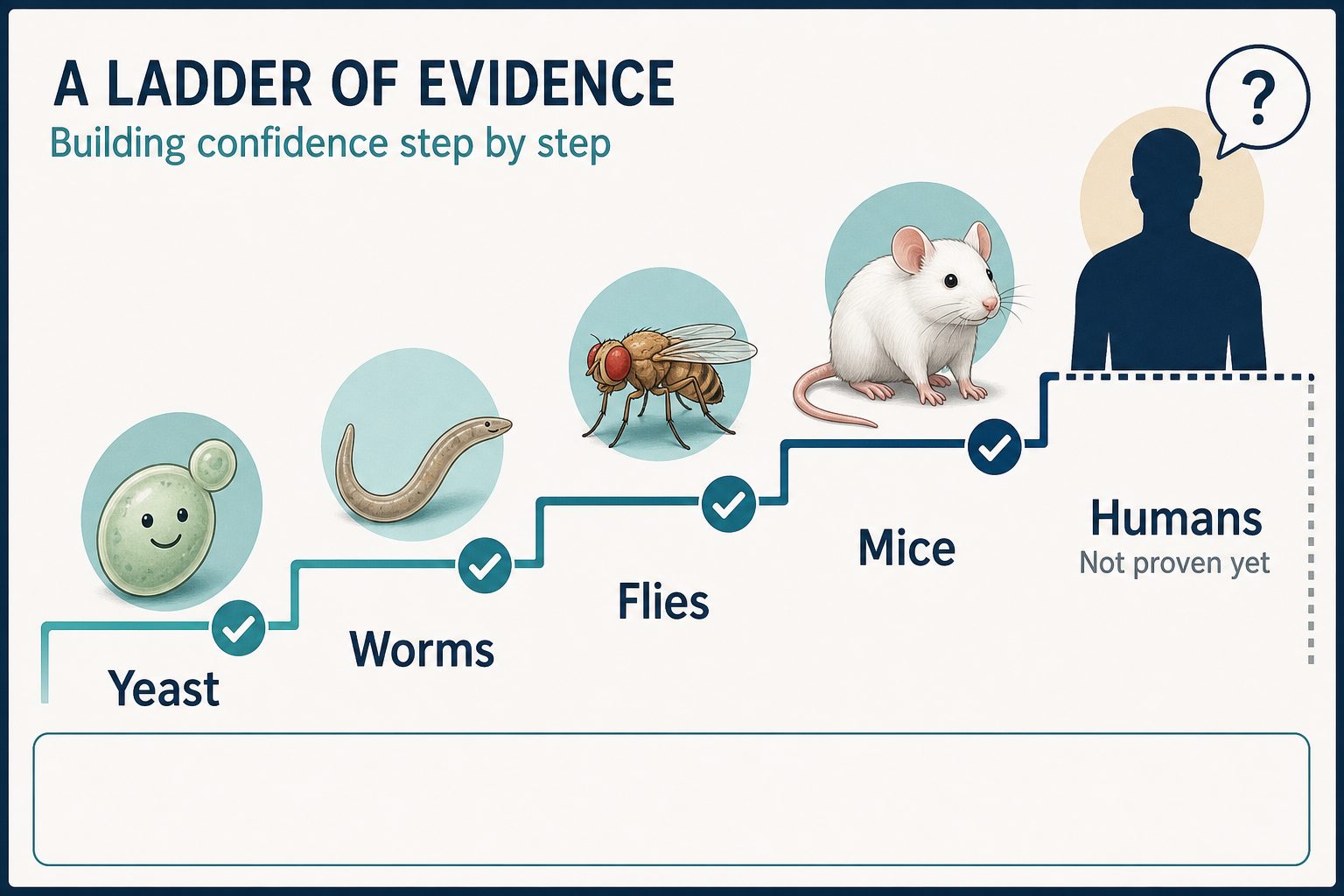
Yeast, worms, flies, mice: the signal repeats. Reviews quote roughly 25–60% lifespan shifts by species; the number moves with the experiment. Harrison and colleagues in 2009 started the drug in 20-month-old mice: females lived ~14% longer, males ~9% (Nature). “It only works in the young” got weaker.
Pelton turns those percentages into “about seven extra human years.” Cute arithmetic. A 30-month caged mouse is not a night-shift, Sunday-breakfast person.
The human study everyone waves is Joan Mannick, 2014: 218 people over 65, not rapamycin but its analog everolimus (RAD001), six weeks, then a flu shot. The 5 mg once-weekly arm had ~20% better antibody titers than placebo; daily low dose or a higher weekly dose was less impressive (Science Translational Medicine). That is not “the immune system got 20% younger,” and it is not “5–6 mg rapamycin for everyone.” Short trial, analog, vaccine titers.
Dog echocardiograms, the Dog Aging Project — the ladder is still being built. The top rung is dotted.
Longevity pill or transplant drug?
Licensed uses: kidney-transplant rejection, LAM. Analogs (everolimus) are other boxes. No approved aging indication.
Daily transplant dosing suppresses immunity; the label warns about infection and certain cancers (DailyMed Rapamune). Pelton writes that weekly use is “very safe,” mouth ulcers fade if you drop the dose. Aphthous ulcers are real. Lipids, glucose, delayed wounds, muscle and bone loss show up when the dose is high or frequent. Children and teens need mTOR to grow; his “generally not under 30” note is reasonable there.
Stopping a medicine because “it causes addiction” was a myth we already took apart in blood-pressure medications and addiction. Starting rapamycin from a forum protocol is haste from the same family.
Foreign pharmacies, no prescription, “biohacker lists” — I will not recommend that.
If not a pill, what is left?
Time. Pelton sells 16:8 (a shorter eating window) as an autophagy shift. It asks for discipline and does not fit everyone. Do not crush muscle, glucose, or a social life. Movement, sleep, closing the kitchen at night — dull, studied ways to ease mTOR.

Read Pelton for the mechanism. Not for a prescription. Your own list, a wound, a transplant, pregnancy — different conversation. You can request an appointment from the contact page. How I work is on About.
FAQ
Are rapamycin and sirolimus the same?
Same active drug. Rapamune is the brand. Everolimus is a cousin, not a copy — that is the Mannick trial.
Did Pelton prove longevity?
No. A review and a commentary. He gathers mouse and Mannick data. “Everyone should take it” is not a guideline.
What did Harrison show?
Late-life rapamycin in old mice stretched lifespan (~14% females, ~9% males). Do not convert that into human years.
Can I buy a weekly dose online?
No purity, no dose, no follow-up. Infection and wounds are real. I will not dress that up as an experiment.
Scientific sources
- Pelton R. Rapamycin: extending health span and life span — PMC9173851
- Harrison DE et al. Rapamycin fed late in life extends lifespan in mice — Nature, 2009
- Mannick JB et al. mTOR inhibition improves immune function in the elderly — Sci Transl Med, 2014
- Rapamycin and longevity, pros and cons — Frontiers in Aging, 2025
- Rapamune (sirolimus) label — DailyMed