

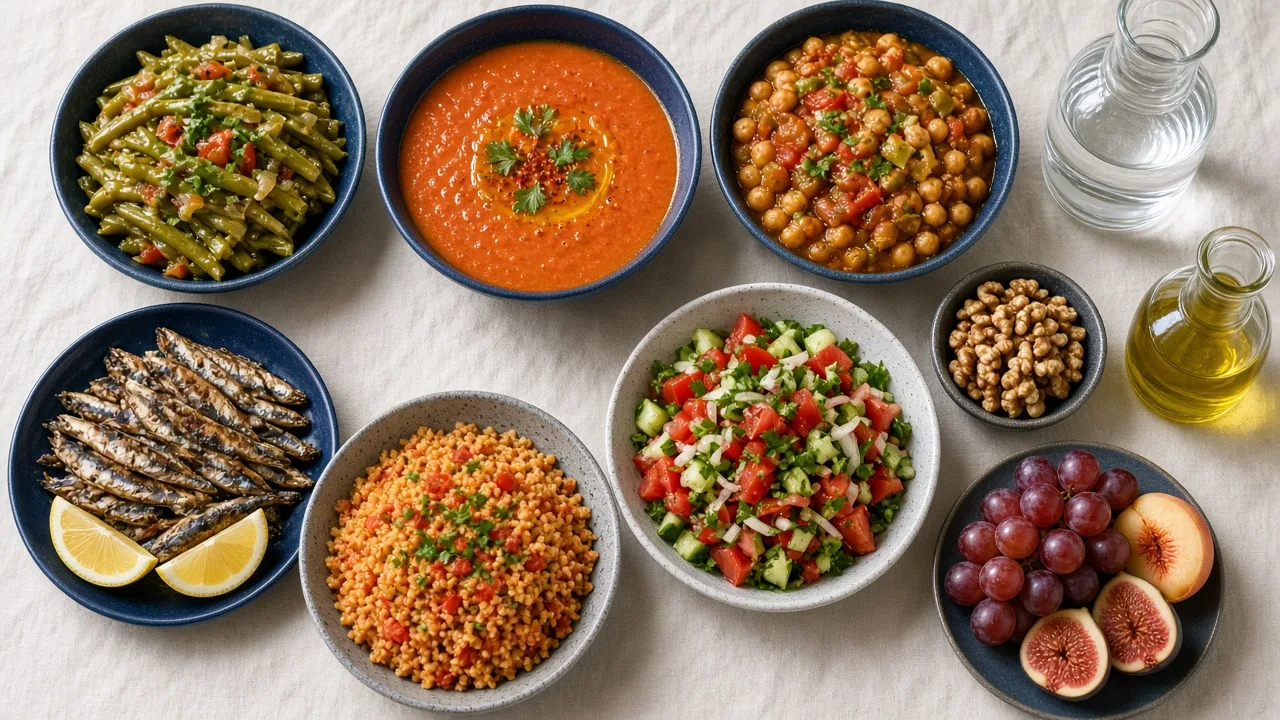
Protecting your arteries does not require inventing a new cuisine. Olive-oil vegetable dishes, lentils and chickpeas, bulgur pilaf, yoghurt, seasonal salads and anchovies are already part of Turkish cooking. The problem is that everyday life has pulled us away from that table: white bread, pastries, sugary drinks, processed meat, fried food and too much salt. I do not suggest a new cuisine to my patients; I suggest returning to the best side of our own.
In this article I will cover the studies showing how diet affects vascular health, the guideline advice on fat, fibre, salt and sugar, and how to bring it to a Turkish table. I explained the effect of diet on LDL cholesterol in how to lower cholesterol, and its effect on triglycerides in how to lower triglycerides.
Why a pattern, not a single food?
I often hear the question, “Which food is good for cholesterol?” The honest answer is that there is no strong evidence that any single food protects the arteries. The evidence is for a dietary pattern kept up for years. In that pattern, the type of fat, the amount of fibre, salt, sugar, meat and processed food all change together. Blood pressure, cholesterol, blood sugar and weight improve together too.
That is why the 2021 European Society of Cardiology prevention guideline recommends not a particular food, but a Mediterranean-style or similar diet.
What does the evidence say?
The PREDIMED trial was carried out in Spain in 7,447 people who did not yet have cardiovascular disease but were at high risk. Participants were assigned to three groups: a Mediterranean diet enriched with extra-virgin olive oil, a Mediterranean diet enriched with nuts, and a reduced-fat control diet. Over a median 4.8 years, heart attack, stroke and cardiovascular death were about 31% less common in the olive oil group and about 28% less common in the nut group than in the control group. The trial’s first report from 2013 was retracted in 2018 after it emerged that group assignment had not followed the protocol at some sites. The data were reanalysed with these errors taken into account and republished the same year with similar findings. I think this is worth saying: good science corrects its mistakes in the open.
The CORDIOPREV trial compared a Mediterranean diet with a low-fat diet in 1,002 people with coronary heart disease. Over seven years, major cardiovascular events occurred in 87 people in the Mediterranean group and 111 in the low-fat group. Risk was about a quarter lower. The effect was clear in men; because only 18% of participants were women, no difference could be shown in women.
Both trials were carried out in Spain. There is no outcome trial of similar size using Turkish cuisine. But the cornerstones of these diets, olive oil, vegetables, pulses, whole grains, fish and nuts, are on our table too.
The artery-friendly plate
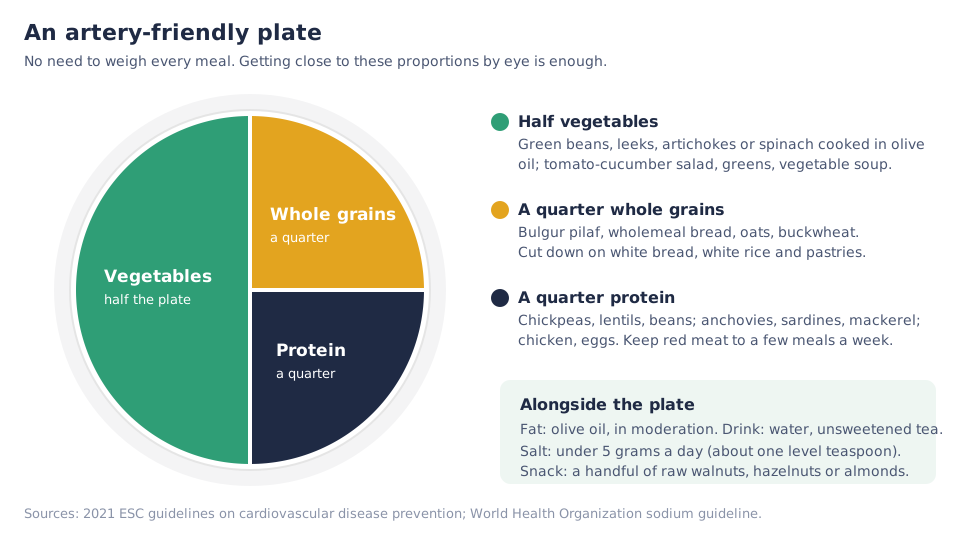
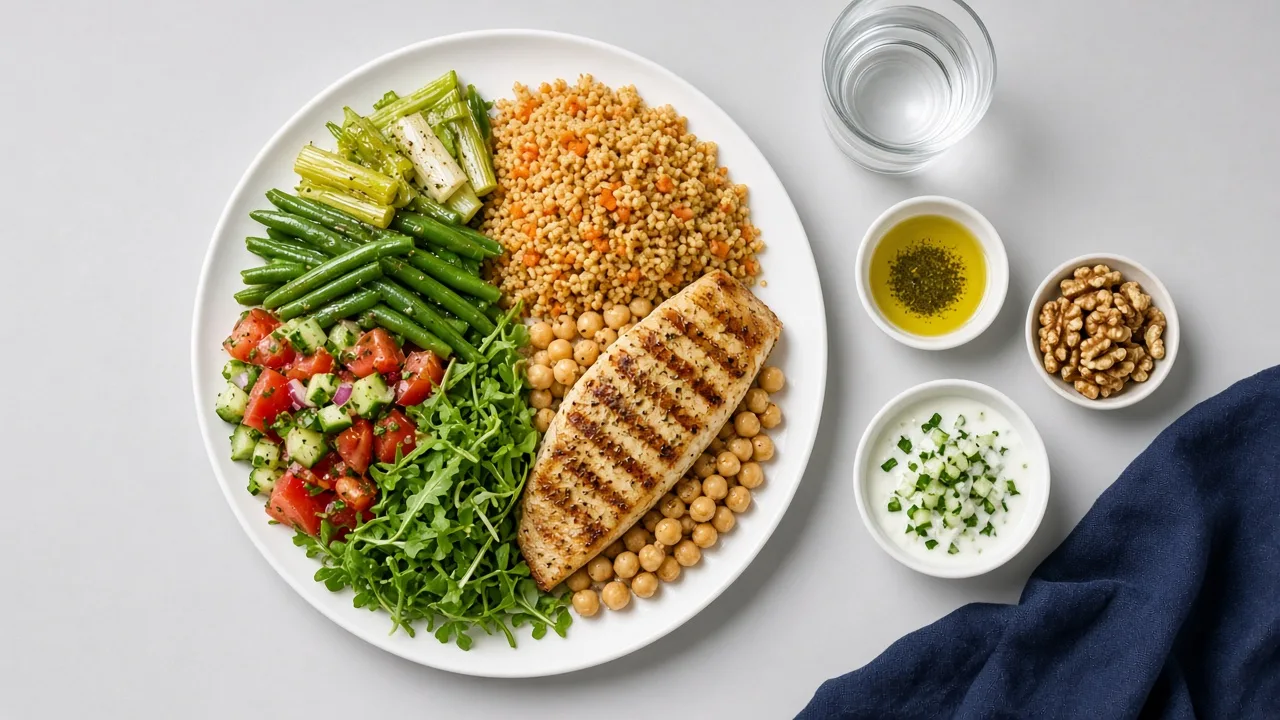
This model is easy to translate into Turkish cooking. Olive-oil green beans, leeks, artichokes or spinach can fill half the plate. Add a ladle of bulgur pilaf and a bowl of lentils or chickpeas, and the plate is complete. On one or two days a week, swap the protein for anchovies, sardines or mackerel.
Fat: which kind, and how much?
The most consistent way to lower LDL cholesterol through diet is to cut saturated fat and replace it with unsaturated fat. The European guideline recommends that saturated fat provide no more than 10% of daily energy. Butter, tail fat, kaymak (clotted cream), sucuk, salami, too much full-fat cheese and pastries are the main sources of saturated fat.
Trans fat should be kept as low as possible. It is found in older types of margarine, some ready-made pastries and frying oil that has been reused again and again.
Olive oil is the foundation of this pattern, but it is still a fat and high in calories. One tablespoon has about 120 calories. Use olive oil instead of butter, not on top of it. Adding it with a spoon rather than straight from the bottle is the easiest way to control the amount.
Fibre, pulses and whole grains
The guideline recommends 30–45 grams of fibre a day, preferably from whole grains. It also recommends at least 200 grams of vegetables and 200 grams of fruit a day. That is roughly two to three portions of vegetables and two to three portions of fruit.
Turkish cuisine is rich here. Bulgur, white beans, chickpeas, green and red lentils, borlotti beans and oats provide both fibre and plant protein. The soluble fibre in oats, barley and pulses lowers LDL further. You do not have to give up white bread entirely, but switching to wholemeal or rye bread and making the portion smaller makes a difference.
Fish and nuts
The guideline recommends fish at least once a week, preferably oily fish. Anchovies, sardines, horse mackerel, mackerel and bonito are oily and easy to find in season. Choose grilling, baking or steaming over frying.
Thirty grams a day, about a handful, of unsalted nuts is also among the recommendations. Walnuts, hazelnuts and almonds are good choices. Pick raw or unsalted nuts rather than roasted and salted ones, and because they are high in calories, do not go beyond a handful.
Meat and processed meat
The European prevention guideline advises limiting red meat to at most 350–500 grams a week and keeping processed meat to a minimum. Sucuk, salami, sausages and pastırma contain both saturated fat and a lot of salt. At breakfast, a boiled egg or an egg cooked in a little oil instead of eggs with sucuk; at dinner, pulses on two days and fish on one or two days a week instead of red meat every day, is a good balance.
Salt: the easiest to overlook
The World Health Organization recommends less than 5 grams of salt a day for adults, which is about one level teaspoon. In the SALTURK study carried out in Türkiye in 2008, daily salt intake measured by 24-hour urine collection was about 18 grams. In the 2017 Turkey Nutrition and Health Survey this had fallen to about 10 grams, but that is still twice the recommended amount.
Most salt comes not from the salt shaker but from prepared food. Bread, white cheese, olives, pickles, tomato and pepper paste, packet soups, processed meat, crisps and ready-made sauces are the main sources. Most bottled ayran also has added salt. Not salting food before tasting it, using flavours such as lemon, sumac, thyme, mint and chilli flakes instead, reading labels, and eating pickles and brined foods only occasionally all help.
In the SSaSS trial in China, about 21,000 people who had had a stroke, or were over 60 with high blood pressure, replaced their regular salt with a salt substitute in which part of the sodium was replaced by potassium. Over nearly five years, strokes were 14% less common. However, people with kidney disease or at risk of high potassium were not included. If you have kidney disease, or take medicines for blood pressure, heart failure or fluid retention, talk to your doctor before switching to potassium salt; blood potassium can rise to dangerous levels.
Sugar, drinks and alcohol
The guideline clearly recommends avoiding sugary drinks such as cola, fizzy drinks and fruit juice. In a US study that followed nurses for many years, women who had two servings of sugary drinks a day had about a 35% higher risk of coronary heart disease than those who had one a month. Tea itself is not the problem; the sugar you add to it counts.
The upper limit for alcohol is 100 grams of pure alcohol a week. Because a standard drink contains 8 to 14 grams of alcohol depending on the country, this equals about 7 to 12 drinks a week. Less is better. For someone with high triglycerides, I advise stopping alcohol completely.
Swap, don’t ban
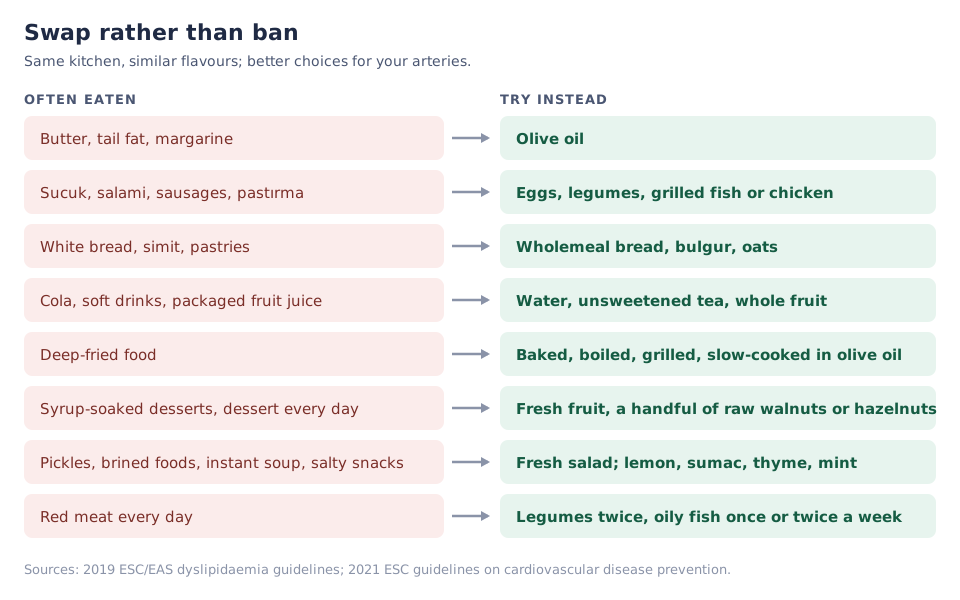
The most common mistake I see is banning everything at once and going back to old habits a few weeks later. Making one change a week lasts longer. For example, drop sugary drinks in the first week, switch to wholemeal bread in the second, and set aside one evening for fish in the third.
A sample day
- Breakfast: A boiled egg or a small slice of low-salt white cheese, plenty of tomato, cucumber and greens, a few olives, one or two slices of wholemeal bread and unsweetened tea. Alternatively, oats cooked in milk topped with fresh fruit and a few walnuts.
- Lunch: Lentil soup, a ladle of bulgur pilaf, shepherd’s salad and cacık.
- Snack: A portion of fresh fruit and a handful of raw hazelnuts.
- Dinner: Olive-oil leeks or green beans, with a chickpea dish, or on one or two evenings a week grilled anchovies or sardines, and a salad.
This is an example, not a prescription. People with diabetes, kidney disease, heart failure, coeliac disease or food allergies need an individually planned diet. If you take warfarin, do not cut out green leafy vegetables; eat a similar amount each week and tell your doctor about any changes. In these situations I recommend working with a dietitian.
Can diet replace medication?
For some people yes, for others no. For someone with mildly raised LDL and low risk, a good dietary pattern may be enough on its own. For someone who has had a heart attack or whose LDL is above 190 mg/dL, diet sits alongside medication, not in place of it. Most patients in CORDIOPREV were also taking a statin; the Mediterranean diet lowered risk on top of medication.
Conclusion
A diet that puts your arteries first is not a foreign diet but a table Turkish cuisine already knows: plenty of vegetables, olive oil, pulses, bulgur, fish, yoghurt and nuts. What needs to change is what has been added to that table in recent years: white flour, sugar, processed meat, fried food and too much salt. Doing this with small, lasting changes rather than bans gives the best results.
If you would like your cholesterol, triglyceride or blood pressure results assessed together with your vascular health, you can request an appointment through our contact page.
Frequently asked questions
Can I use as much olive oil as I like?
No. Olive oil is one of the best fat choices, but it is high in calories. Use it in place of other fats and measure it with a spoon.
Is butter completely off the menu?
Using a little now and then causes no problem for most people. The problem is using it every day and in every dish. For people with very high LDL, we discuss a stricter limit.
Do I need to give up bread?
No. Choose wholemeal or rye bread instead of white, and make the portion smaller. Let bread accompany the meal rather than be the main part of it.
Can I eat eggs?
One egg a day does not cause a meaningful rise in most people whose LDL is not very high. Cooking it with sucuk, kavurma (preserved fried meat) or plenty of butter changes the picture.
Should I take supplements or herbal products for cholesterol?
Guidelines do not recommend products that do not meaningfully lower LDL and whose safety has not been shown. I covered this, with a comparative trial, in how to lower cholesterol.
Scientific sources:
- Visseren FLJ, Mach F, Smulders YM, et al. 2021 ESC Guidelines on cardiovascular disease prevention in clinical practice. European Heart Journal. 2021;42:3227–3337.
- Mach F, Baigent C, Catapano AL, et al. 2019 ESC/EAS Guidelines for the management of dyslipidaemias. European Heart Journal. 2020;41:111–188.
- Estruch R, Ros E, Salas-Salvadó J, et al. Primary prevention of cardiovascular disease with a Mediterranean diet supplemented with extra-virgin olive oil or nuts (PREDIMED). New England Journal of Medicine. 2018;378:e34.
- Delgado-Lista J, Alcala-Diaz JF, Torres-Peña JD, et al. Long-term secondary prevention of cardiovascular disease with a Mediterranean diet and a low-fat diet (CORDIOPREV). Lancet. 2022;399:1876–1885.
- Neal B, Wu Y, Feng X, et al. Effect of salt substitution on cardiovascular events and death (SSaSS). New England Journal of Medicine. 2021;385:1067–1077.
- World Health Organization. Guideline: sodium intake for adults and children. Geneva: WHO; 2012.
- Erdem Y, Arici M, Altun B, et al. The relationship between hypertension and salt intake in Turkish population: SALTURK study. Blood Pressure. 2010;19:313–318.
- Republic of Türkiye Ministry of Health, National Nutrition Council. Salt Science Commission report (in Turkish). 2025.
This article is for general information only and does not replace a diagnosis, personal treatment or a personal nutrition plan. If you have a chronic condition, plan dietary changes with your doctor or dietitian. The images in this article are AI-generated illustrative images; they do not show a real person, patient or brand.