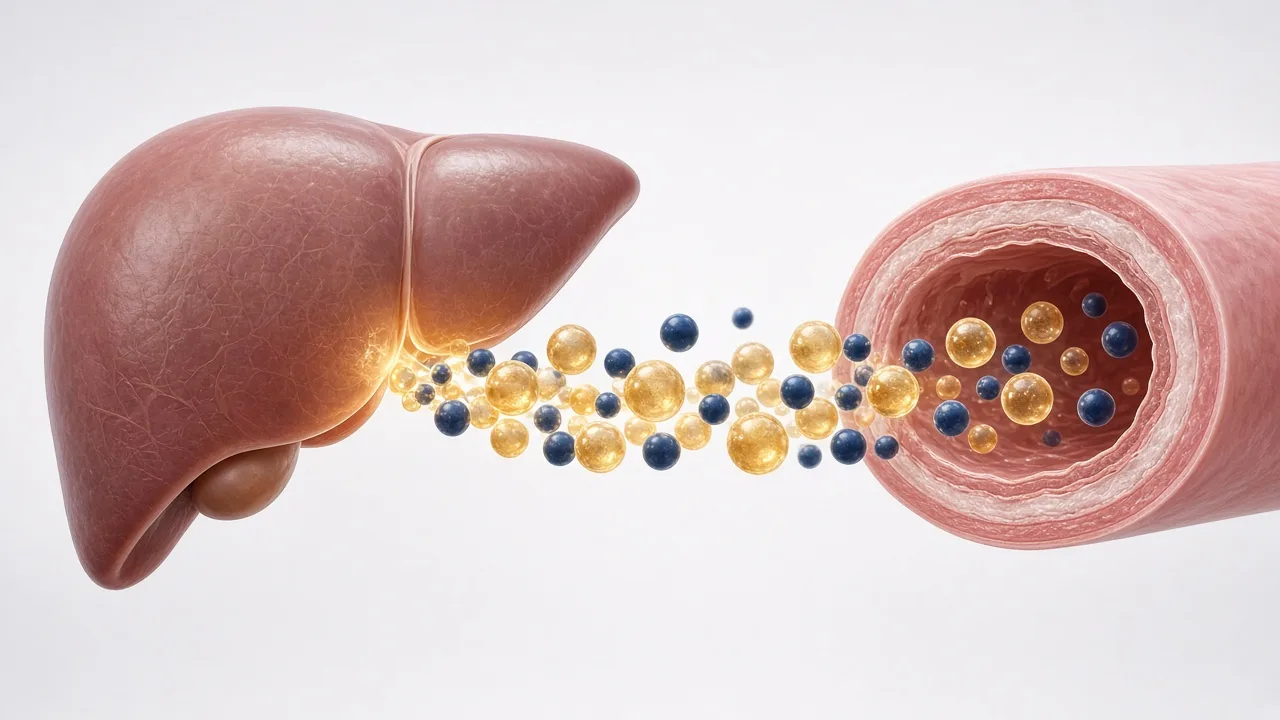



A patient recently put his lab report on my desk and said: “My LDL is 110, which is below the reference. So I am fine.” His triglycerides were 260. In that picture, LDL alone gives no reassurance. What matters is how many particles are carrying cholesterol into the artery wall, not only how much cholesterol they carry. That is exactly what ApoB measures.
In this article I will explain three lines I see more and more often on lab reports: ApoB, ApoA1 and Lp(a). All three are about the particles that carry cholesterol rather than cholesterol itself. We covered the carriers in our article what is cholesterol; this article picks up from there.
What is ApoB?
ApoB is a protein that sits on the surface of the carrier particle. Every artery-damaging carrier, including VLDL, its remnants, LDL and Lp(a), carries exactly one ApoB molecule. That is why the ApoB level in the blood corresponds almost one-to-one with the number of these carriers.
LDL cholesterol measures something different: the total amount of cholesterol inside those carriers. You can separate the two like this. LDL is the weight of the cargo the trucks carry. ApoB is the number of trucks on the road. What sneaks into the artery wall and grows plaque is the truck itself, not how heavy its load is.

Why can ApoB be high when LDL is normal?
When triglycerides rise, in diabetes, in insulin resistance and with fat around the waist, the carriers circulating in the blood become smaller and more numerous. Each one carries less cholesterol, so LDL can look normal or even low. But there are more particles, so more of them can enter the artery wall. ApoB captures that increase; LDL does not.
The reverse can happen too. Some people with high inherited cholesterol have fewer but larger carriers. LDL looks high, while ApoB is not as high as one might expect.
That is why I order ApoB in particular when:
- Triglycerides are above 150 mg/dL
- There is diabetes, insulin resistance or marked fat around the waist
- LDL appears to be at target but heart disease is still progressing
- There is early heart disease in the family
ApoB is also a more stable measure than non-HDL cholesterol. Its biological variation is lower, it is reliable without fasting, and it changes less between repeated measurements. When triglycerides are very high, the LDL calculation can mislead; ApoB does not.
What is the ApoB target?
The European guideline suggests ApoB as a second target, checked once the LDL target has been reached. The target falls as risk rises:
- Moderate risk: below 100 mg/dL
- High risk: below 80 mg/dL
- Very high risk: below 65 mg/dL
- Below 55 mg/dL may be considered after a second vascular event within two years, while on the highest tolerated statin dose
The guideline does not set a separate ApoB goal for low risk.
Which risk group you fall into depends on your age, blood pressure, smoking, diabetes and past events such as a heart attack or stroke. Do this calculation with your doctor. The reference range printed by the laboratory is the same for everyone and may not be your target.
What is ApoA1, and does the ratio matter?
ApoA1 is the main protein of HDL. HDL collects surplus cholesterol from tissues and carries it back to the liver, so ApoA1 is counted on the “good” side. The European laboratory consensus recommends flagging ApoA1 at or below 125 mg/dL as low. This is not a treatment target, and the cut-off can vary by laboratory.
A ratio is also calculated by dividing ApoB by ApoA1. In large population studies this ratio is linked with heart disease risk, and some centers use 0.9 as an interpretation threshold. I do not base treatment decisions on this ratio, for two reasons. First, when ApoA1 falls, the ratio rises; yet raising ApoA1 with medicine has not been shown to reduce heart attacks. Second, the most reliable way to lower the ratio is to lower its numerator, ApoB. So the ratio is a useful extra piece of information, while our target is ApoB itself.
What lowers ApoB?
Anything that lowers LDL also lowers ApoB, because the two largely describe the same carriers. Statins, ezetimibe (which reduces cholesterol absorbed from the intestine), bempedoic acid and the new generation of cholesterol injections all lower ApoB markedly. When triglycerides are high, lowering them also helps ApoB, because the number of VLDL particles falls.
The effect of diet on ApoB varies from person to person. Reducing saturated fat, increasing fibre and losing weight produce a measurable drop in most people. I will go into the detail in later articles of this series. The effects of the medicines on ApoB and Lp(a) are discussed in our article on next-generation cholesterol injections.
What is Lp(a)?
Lp(a), read “lipoprotein little a,” is in fact an LDL particle with a second protein, apo(a), attached to it. That protein has a structure similar to a component of the system that dissolves clots. The particle can both enter the artery wall and make it harder for clots to dissolve. It is also linked with calcification and narrowing of the aortic valve.

Why is Lp(a) not changed by diet or exercise?
Because its production is set in the liver by genes. Losing weight, exercising and reducing saturated fat lower LDL and ApoB, but they have no meaningful effect on Lp(a). Statins do not lower it either. When the individual data from seven large statin trials were pooled, statins did not meaningfully lower Lp(a) levels.
About 90% of the level of Lp(a) is determined by the LPA gene. This gene also determines how many repeating units the apo(a) chain has. A shorter chain is produced faster by the liver, and Lp(a) rises in the blood. The level is largely set in the early years of life and then changes little. It can rise somewhat after menopause in women and is higher in kidney failure.
Lp(a) above 50 mg/dL, the level at which risk rises, is found in about one in five people. The pattern runs in families: if a parent has a high level, a child is more likely to have one too.
This does not mean there is nothing to do. The opposite is true: when a risk cannot be changed, the modifiable risks become more important. Keeping LDL, blood pressure, smoking and blood sugar tightly under control is the proven path we have.
When and how is Lp(a) measured?
The European guideline recommends that every adult has Lp(a) measured at least once in their life. I add it to the first comprehensive cholesterol test. I do not postpone it in these situations:
- Early heart attack, stroke or sudden death in the family
- Early-onset vascular disease in the person themselves
- A diagnosis or suspicion of familial hypercholesterolemia
- LDL falling more slowly than expected despite treatment
- Narrowing of the aortic valve
Two traps when reading the result. First, laboratories use two different units: mg/dL and nmol/L. There is no fixed conversion factor between them, because the length of the apo(a) chain differs from person to person. Do not convert your own result by multiplying by 2 or 2.5; that calculation can place you in the wrong group. Second, methods differ, so the same blood can give different results in different laboratories. If you want to compare results over time, use the same laboratory.
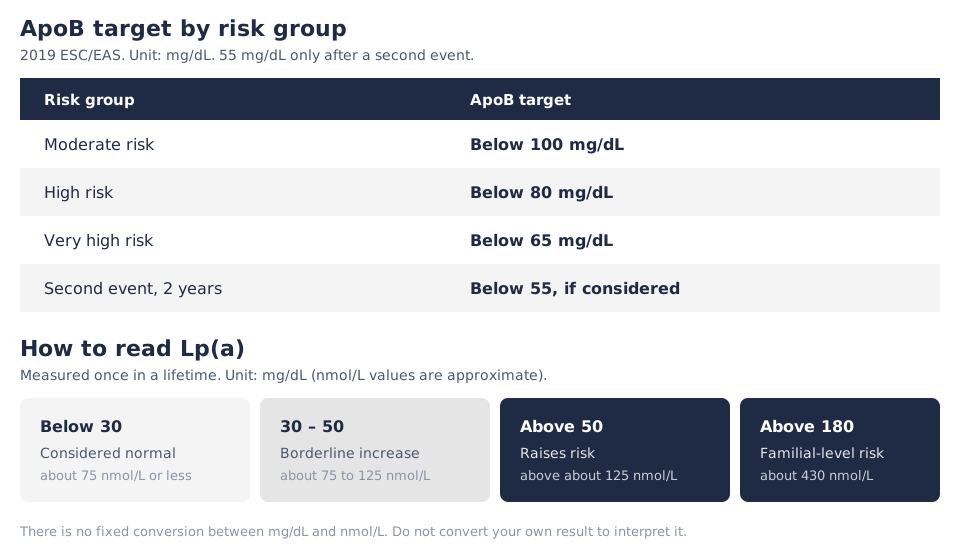
In practice I read the result roughly like this. Below 30 mg/dL (about 75 nmol/L) is considered normal. Between 30 and 50 is a borderline increase. Above 50 mg/dL raises risk and applies to about one in five people. There is no fixed nmol/L equivalent: the 2022 consensus cites about 125 nmol/L, and the 2025 guideline update cites about 105 nmol/L. Above 180 mg/dL (about 430 nmol/L) is considered a risk on the level of familial hypercholesterolemia, which alone is significant.
The 2025 guideline update treats Lp(a) above 50 mg/dL (about 105 nmol/L) as a risk-enhancing finding. It recommends reassessing risk in people at moderate risk or close to a treatment threshold.
What is the situation with Lp(a)-lowering drugs?
I want to be clear about this, because news in this field moves quickly. Injections that block Lp(a) production can lower Lp(a) in the blood by about 80% to more than 95%, depending on the drug and dose. The expectation was that this reduction would also reduce heart attacks and strokes.
The first large trial to test that expectation reported in 2026. Pelacarsen, an antisense drug, was tested in more than 8,300 people with established cardiovascular disease and high Lp(a). It lowered Lp(a) by about 78%. But over a median of 4.7 years, the combined rate of cardiovascular death, heart attack, stroke and urgent artery-opening procedures was the same as with placebo: about 12% in both groups. The result was the same in the subgroup with the highest Lp(a) levels.
This result does not change three things, but it does change one. Lp(a) is still a strong risk marker and should continue to be measured. In a person with a high level, modifiable risks such as LDL, blood pressure and smoking should be managed more tightly. What changes is this: we cannot yet say “there is an injection that lowers your Lp(a) and therefore your risk.” Other drugs aimed at the same target are still being tested, and their results could reopen the question. Until then, our decisions rest on proven treatments.
Conclusion
When reading a cholesterol panel, the number of carriers matters more than the weight of their cargo. ApoB gives that count and reveals a risk that LDL can miss. ApoA1 and the ratio between the two are extra information; the treatment target is ApoB. Lp(a) is measured once, is largely inherited, and is a risk we cannot yet reliably lower with a drug. If it is high, treat it not as fate but as a reason to manage every other risk factor more firmly.
If you would like to review your ApoB or Lp(a) result together with your vascular health, you can request an appointment through our contact page.
Frequently asked questions
Do I need to fast before an ApoB test?
No. ApoB is reliable even after a meal. If your triglycerides are not very high, fasting is usually not needed for the full cholesterol panel.
My LDL is at target but my ApoB is high. Which should I believe?
ApoB. Especially in people with high triglycerides, diabetes or insulin resistance, LDL can underestimate the number of carriers. We review treatment against the ApoB target.
My Lp(a) came back high. Should I repeat the test?
Usually not. The level stays largely stable throughout life, so one measurement is enough. If another laboratory gives a very different result, it is reasonable to confirm once with the same method.
Is there a medicine that lowers Lp(a)?
Drugs that lower Lp(a) in the blood have been developed, but none has yet been proven to reduce heart attacks and strokes. The first large trial of this type, pelacarsen, reported in 2026 and did not reduce events. Other trials are ongoing.
Should my child be tested for Lp(a)?
If there is a very high Lp(a) or early heart disease in the family, a single measurement in childhood or young adulthood may be considered. Agree the timing with your doctor, and only test if the result would change monitoring decisions.
Scientific sources:
- Mach F, Baigent C, Catapano AL, et al. 2019 ESC/EAS Guidelines for the management of dyslipidaemias. European Heart Journal. 2020;41:111–188.
- Mach F, Koskinas KC, Roeters van Lennep JE, et al. 2025 Focused Update of the 2019 ESC/EAS Dyslipidaemia Guidelines. European Heart Journal. 2025;46:4359–4378.
- Sniderman AD, Thanassoulis G, Glavinovic T, et al. Apolipoprotein B particles and cardiovascular disease: a narrative review. JAMA Cardiology. 2019;4:1287–1295.
- Ference BA, Kastelein JJP, Ray KK, et al. Association of triglyceride-lowering LPL variants and LDL-C-lowering LDLR variants with risk of coronary heart disease. JAMA. 2019;321:364–373.
- Nordestgaard BG, Langsted A, Mora S, et al. Fasting is not routinely required for determination of a lipid profile. European Heart Journal. 2016;37:1944–1958.
- Kronenberg F, Mora S, Stroes ESG, et al. Lipoprotein(a) in atherosclerotic cardiovascular disease and aortic stenosis: a European Atherosclerosis Society consensus statement. European Heart Journal. 2022;43:3925–3946.
- Willeit P, Ridker PM, Nestel PJ, et al. Baseline and on-statin treatment lipoprotein(a) levels for cardiovascular risk stratification: an individual patient-level analysis of seven randomised trials. Lancet. 2018;392:1311–1320.
- Tsimikas S, Karwatowska-Prokopczuk E, Gouni-Berthold I, et al. Lipoprotein(a) reduction in persons with cardiovascular disease. New England Journal of Medicine. 2020;382:244–255.
- O’Donoghue ML, Rosenson RS, Gencer B, et al. Small interfering RNA to reduce lipoprotein(a) in cardiovascular disease. New England Journal of Medicine. 2022;387:1855–1864.
- Lp(a)HORIZON trial investigators. Pelacarsen and cardiovascular events in patients with high lipoprotein(a): the Lp(a)HORIZON trial. New England Journal of Medicine, published online 7 November 2026.
- American Heart Association. Lp(a) HORIZON trial: Lp(a) fell by 78%, but cardiovascular outcomes unexpectedly neutral. 7 November 2026.
This article is for general information only and does not replace a medical diagnosis or personal treatment advice. Your ApoB target and the meaning of your Lp(a) result should be determined by your doctor through a personal risk assessment.