

Hallmarks of Aging: What Do They Mean for Your Heart and Vessels?
In clinic I sometimes hear: “I have high blood pressure and cholesterol… I guess I’m just getting old. Have my arteries ‘worn out’?”
The worry is real. Age is one of the strongest cardiovascular risk factors. Saying “I’m getting older,” though, is not a diagnosis by itself. In 2013, López-Otín and colleagues described aging with nine shared biological hallmarks in their Cell review, The Hallmarks of Aging. It reads like lab language. When we talk plaque, stiff vessels, and heart attack, we are often looking at the same ground.
Note: This article is general information. It is not a personal diagnosis or treatment plan.
For arterial disease basics see arterial diseases. If early events run in the family, see early heart attack and genetic risk.
What does “hallmarks of aging” mean?
Short answer: Common breakdown paths that show up with age—and that experiments can speed up or slow down.
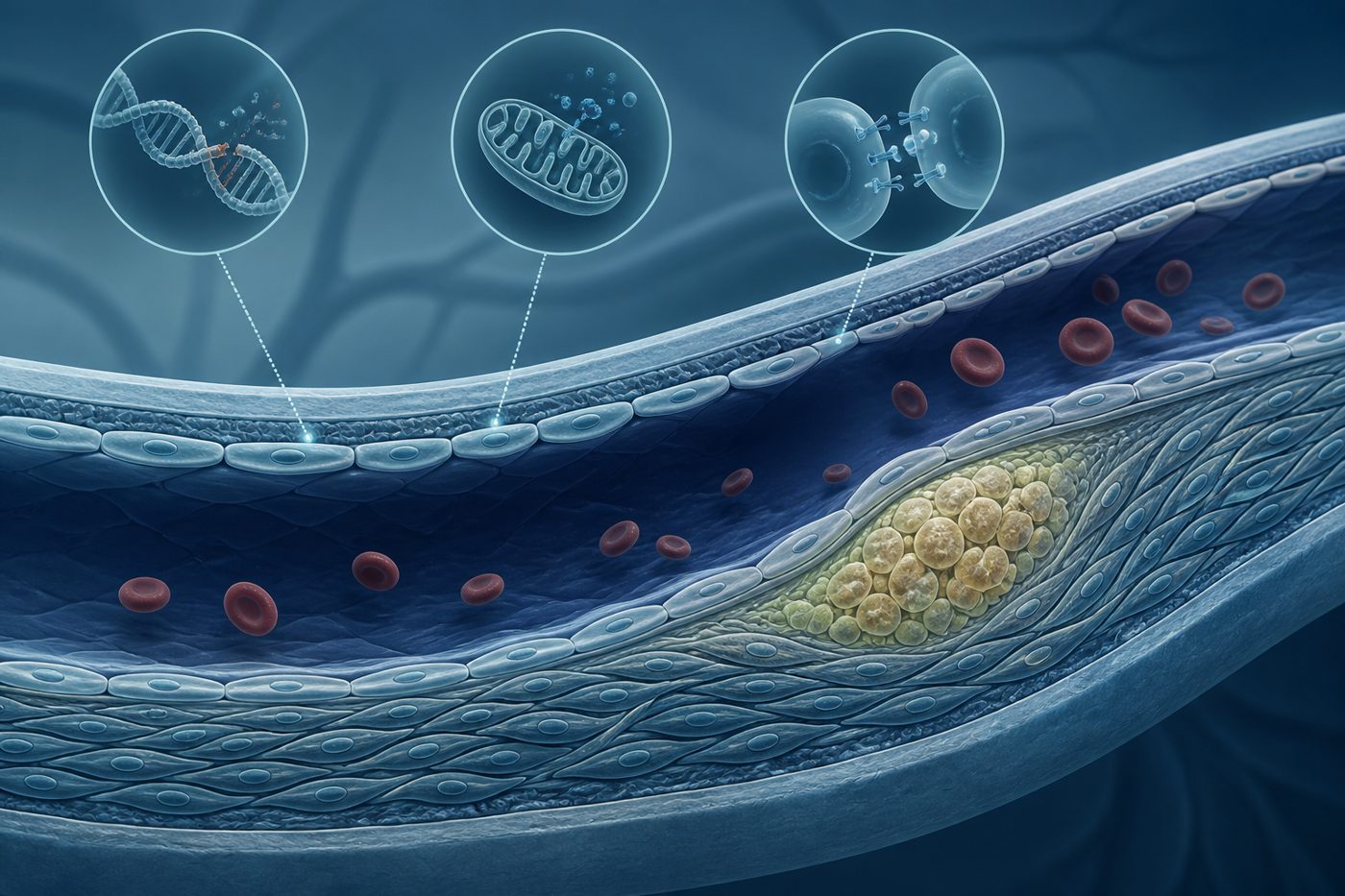
The nine candidates are genomic instability, telomere attrition, epigenetic alterations, loss of proteostasis, deregulated nutrient sensing, mitochondrial dysfunction, cellular senescence, stem cell exhaustion, and altered intercellular communication. The point was not to sell an “anti-aging pill,” but to name which pathways might matter for healthier years. The review is on Cell and in PMC.
Here is how I put it to patients: aging is more than a birthday. If DNA repair, energy production, low-grade inflammation, and cell messaging drift, the endothelium and vessel wall tire early too.
Why do DNA damage and telomeres matter for vessels?
Short answer: When DNA frays and telomeres shorten, repair gets harder—and vessel cells share that load.
Genomic instability is damage piling up faster than repair. Telomeres are caps on chromosome ends; they can shorten as cells divide. The paper counts that among the main hallmarks. I do not tell anyone that one commercial telomere number “explains everything.” Smoking and chronic disease still raise the load in endothelial and vessel-wall cells.
If relatives had early heart attack, sudden death, or widespread arterial disease, I do not wave it off as “normal aging.” Cardiovascular genetic testing and counseling is a concrete next step. Familial hypercholesterolemia can look like early vessel aging.
Why do mitochondria and nutrient pathways matter for the heart?
Short answer: When the cell’s energy factories falter, oxidative stress rises; insulin/IGF and mTOR paths also shape vessel metabolism.
Mitochondria sit near the middle of the framework. Vessel cells need energy; sick mitochondria can leak reactive oxygen and feed inflammation. Insulin/IGF-1, mTOR, AMPK, sirtuins show up often in longevity research. In clinic I hear that as diabetes, central weight, and a metabolism that rarely rests: the vessel lining cannot relax well, and plaque finds room.
No miracle diet. Sugar control, walking, and excess calories can still wear vessels down. I am not exaggerating that.
What are cellular senescence and “inflammatory chatter”?
Some cells stop dividing yet keep releasing irritating signals. That overlaps the long, low-grade inflammation of atherosclerosis.
In the paper, senescence and broken cell-to-cell communication are separate headings. I see a years-long alarm in the vessel wall. Macrophages, platelets, endothelium, and smooth muscle trade inflammatory messages. Plaque grows and may turn unstable. Calf pain on walking, carotid plaque, coronary narrowing—they can all rise from that ground.
Some of those messages travel in extracellular vesicles. That is why I opened inflammation and microcirculation in exosomes and peripheral artery disease: the problem is not only a blocked pipe.
How do proteostasis loss and stem-cell exhaustion show up?
Bad proteins that are not cleared, and fewer repair cells, mean slower recovery.
Loss of proteostasis is that cleanup failure; autophagy is part of the clean-up crew. Stem-cell exhaustion means less regenerative reserve. For vessels and heart muscle I think: after injury, recovery takes longer. Add diabetes or long illness on top of age, and reserve drops—I see that every week.
What can you actually do?
Short answer: The strongest gains are still stopping tobacco, controlling blood pressure–sugar–cholesterol, moving, and using drugs or procedures when needed—not an “anti-aging injection.”
The paper discusses drug targets; that does not mean every marketed product works. My order in clinic is:
- Tobacco first, if present
- Blood pressure, LDL, diabetes, weight, sleep
- Family history; genetics when needed
- Imaging when symptoms warrant it
- Stent, bypass, or open/endovascular treatment when required
For coronary decisions see stent or bypass. For legs see leg artery disease. A molecular map does not replace those steps; it helps explain why some vessels fail early.
I will be direct: we cannot rewind calendar age. We can still lighten some of the load that wears vessels fast. We have said that for years as risk-factor care; the hallmarks paper says it in cell language.
For an evaluation you can request an appointment on the contact page.
Frequently asked questions
What are the nine hallmarks of aging?
Genomic instability, telomere attrition, epigenetic change, loss of proteostasis, deregulated nutrient sensing, mitochondrial dysfunction, cellular senescence, stem-cell exhaustion, and altered intercellular communication. That is the 2013 Cell candidate list; they interconnect, not one villain.
Should I get a telomere test?
Not as a must for everyone. Decisions still rest on risk, symptoms, and imaging. The research field matters; one number does not replace angiography or Doppler.
Is there a drug that slows aging?
There is no approved “aging vaccine” for everyone. Some pathways are under study. In practice the biggest gains still come from proven risk reduction.
Can vessel aging reverse?
Wiping established plaque is rare. Slowing progression and preventing events is realistic. Early control matters.
Scientific sources
- López-Otín C, Blasco MA, Partridge L, Serrano M, Kroemer G. The Hallmarks of Aging. Cell. 2013 — DOI: 10.1016/j.cell.2013.05.039
- PMC full text — PMC3836174
- American Heart Association — cardiovascular disease overview