

This article is for informational purposes only. Diagnosis and treatment require medical evaluation.
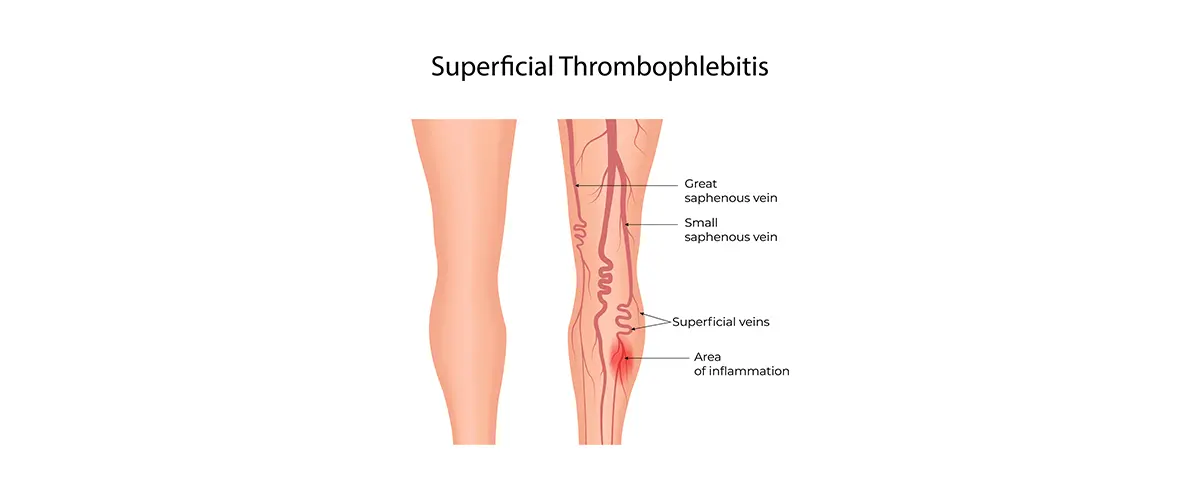
Superficial thrombophlebitis is inflammation and clot formation in a superficial vein. It often appears as a painful, firm, red and tender cord over a varicose vein. Although it is usually less dangerous than deep vein thrombosis, it should not be ignored.
How Is It Different From DVT?
DVT develops in the deep veins and carries a higher risk of pulmonary embolism. Superficial thrombophlebitis affects veins closer to the skin. However, when inflammation is extensive, close to the deep venous junctions or accompanied by major swelling, Doppler ultrasound is needed to rule out deeper involvement.
Symptoms
- Pain and tenderness over a visible vein
- A hard cord-like area under the skin
- Redness and warmth
- Local swelling
- Discomfort that increases with touch or standing
How Is Treatment Planned?
Treatment depends on the length and location of the inflamed vein, symptoms and risk factors. Warm compresses, walking, compression stockings and anti-inflammatory medication may be used in selected patients. Anticoagulation may be considered when the clot is extensive or close to the deep venous system.
Relationship With Varicose Veins
Varicose veins slow blood flow and increase local pressure, which can make superficial thrombophlebitis more likely. After the acute inflammation settles, the underlying varicose vein problem should be assessed with Doppler ultrasound to reduce recurrence risk.
When Is It Urgent?
- Sudden swelling of the whole leg
- Shortness of breath or chest pain
- Rapidly spreading redness
- Fever or severe pain
- Symptoms near the groin or behind the knee
For broader venous evaluation, see Deep Vein Thrombosis and Varicose Veins.