

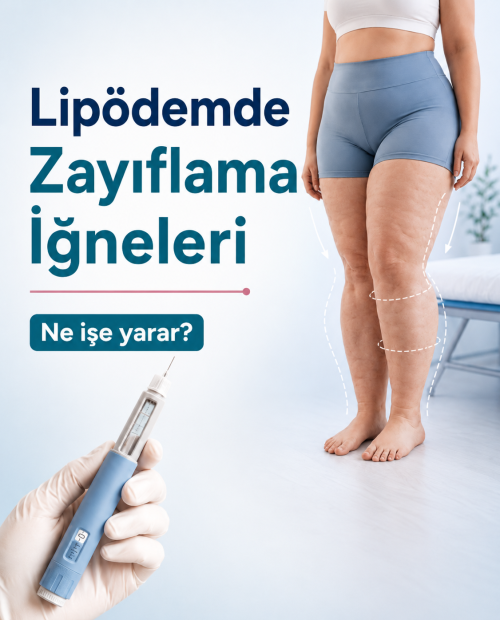
“I’m losing weight, but my legs are not getting slimmer.” This is one of the most common concerns expressed by patients who are evaluated for possible lipedema. Some patients follow a diet for a long time, some begin regular walking, and others use weight-loss medication under medical supervision. Even so, the disproportionate fullness around the hips, thighs, knees or calves may not change as expected.
This does not always mean a lack of willpower, an incorrect diet or insufficient exercise. In some patients, the underlying cause may be lipedema. Lipedema is a chronic condition, seen mostly in women, in which there is a symmetrical, painful and diet-resistant increase in fatty tissue, most commonly in the legs and sometimes in the arms.
For a broader overview of general symptoms, you can read our guide on lipedema symptoms. To understand how lipedema differs from lymphedema, see our guide: lipedema or lymphedema?
Do Weight-Loss Injections Make Lipedema Go Away?
In recent years, GLP-1 based weight-loss medications and similar treatments have been widely discussed, especially on social media. These medications may help some patients with appetite control and overall weight loss. However, lipedema is not simply a problem of “excess weight.” In lipedema, fat distribution, pain sensitivity, tendency to swelling, the lymphatic system and vascular circulation all need to be evaluated together.
For this reason, even when a patient loses weight while using weight-loss injections, the disproportionate fullness in lipedema-affected areas may not decrease at the same rate. If the upper body, face or waist becomes slimmer while the legs remain noticeably unchanged, this can be an important clue for lipedema.
Weight-loss medications should only be used under the supervision of the relevant physician. In patients with suspected lipedema, the goal is not only to reduce the number on the scale, but also to evaluate pain, mobility, swelling, vascular circulation and quality of life together. You can find more information about diagnostic and treatment approaches on our lymphedema and lipedema treatment page.
Why Doesn’t Weight Loss Always Slim the Legs in Lipedema?
Ordinary fat tissue usually responds to weight loss in a more proportional way. In lipedema, however, the issue is not only the amount of fat, but also the structure and distribution of the fatty tissue. Therefore, when a patient loses weight, the trunk, face or waist may become visibly slimmer while the legs show much less change.
Cleveland Clinic notes that lipedema differs from ordinary body fat and that affected areas may not respond to diet and exercise in the same way as typical fat tissue. You can review the source on the Cleveland Clinic lipedema information page.
This situation can also be psychologically difficult for patients. A person may make a serious effort and still not see the expected change in leg appearance. The important point is not to blame the patient, but to make the right medical assessment.
What Are Diet and Exercise Useful for in Lipedema?
Diet and exercise do not eliminate lipedema by themselves, but this does not mean they are useless. Balanced nutrition can support general weight control and reduce the additional burden of obesity on lipedema. I explain which foods stand out and what the low-carbohydrate trials actually found in the lipedema nutrition guide, with practical plate examples. Regular, joint-friendly exercise can support circulation, improve muscle strength and contribute to daily mobility.
Walking, swimming, water-based exercises, cycling, Pilates and low-impact strength exercises are often better tolerated in lipedema. The exercise plan should be personalized according to the patient’s pain level, joint condition, body weight and any accompanying vascular problems.
The U.S. Standard of Care for Lipedema describes nutritional guidance, manual therapy, compression garments, pneumatic compression devices and a home exercise plan as parts of conservative care. For the detailed scientific text, see Standard of Care for Lipedema in the United States.
How Can Lipedema Be Distinguished from Cellulite and Localized Fat?
On social media, lipedema is often confused with cellulite or localized fat accumulation. In lipedema, however, appearance is only one part of the picture; the patient’s symptoms are just as important.
- Cellulite is usually noticed as an orange-peel appearance on the skin surface; marked pain and easy bruising are not expected findings.
- Localized fat accumulation is often related to weight gain and may change more proportionally with weight loss.
- Lipedema may present with symmetrical enlargement of both legs, tenderness to touch, easy bruising, a feeling of heaviness and limited slimming of the legs despite weight loss.
If leg swelling, pain or vascular disease accompanies the picture, differential diagnosis becomes even more important. Not every swollen leg is lipedema; varicose veins, venous insufficiency, lymphedema or other systemic causes may produce similar complaints. Our article on what causes leg swelling may also be helpful.
Common Misunderstandings About Lipedema on Social Media
Awareness of lipedema has increased on TikTok and Instagram. This can help many patients ask the right questions. However, comments based on short social media videos are not a substitute for diagnosis.
The most common misunderstandings include:
- Not every thick leg is lipedema.
- Not every patient with lipedema has the same appearance.
- Weight-loss injections are not a stand-alone treatment for lipedema.
- Diet and exercise are not useless, but expectations must be realistic.
- Compression stockings are not used with the same pressure and model in every patient.
- Surgical options are not the first step for everyone.
The NHS states that lipoedema usually affects the legs, can be painful and should be evaluated differently from ordinary weight control. For detailed patient information, you can review the NHS lipoedema page.
When Are Compression, Lymphatic Drainage and Surgery Considered?
Lipedema management does not rely on a single method. In some patients, compression garments may help control pain, heaviness and swelling. However, choosing the right pressure, measurement and garment type is important. You can read more in our compression stockings guide.
Manual lymphatic drainage, appropriate exercise, skin care and weight management may be planned according to the patient. In advanced stages, or in selected patients who do not obtain sufficient relief with conservative approaches, surgical options may be considered. An NCBI Bookshelf review on liposuction for lipedema shows that surgical decisions should be made by considering clinical effectiveness, patient selection and guideline recommendations. See Liposuction for Lipedema: 2022 Update.
When Is a Cardiovascular Surgery Evaluation Needed?
If there is disproportionate enlargement of the legs, pain, easy bruising and limited slimming despite weight loss, evaluation for lipedema may be appropriate. From a cardiovascular surgery perspective, an important point is also to distinguish lipedema from varicose veins, venous insufficiency, lymphedema or arterial disease.
Urgent evaluation is necessary if there is sudden swelling in one leg, redness, increased warmth, marked pain, shortness of breath or chest pain. If there is chronic enlargement of both legs, a feeling of heaviness toward the end of the day, swelling together with varicose veins, or swelling extending to the top of the foot, specialist evaluation should not be delayed.
For lipedema, lymphedema and leg swelling evaluation in Izmir, you can request an appointment through the contact page.
Frequently Asked Questions
Can lipedema be cured with weight-loss injections?
No. Weight-loss injections may help some patients with overall weight loss, but they should not be considered a stand-alone treatment that directly eliminates lipedema. Fat tissue, pain, swelling, circulation and quality of life should be evaluated together.
Does lipedema improve when I lose weight?
General weight loss can be beneficial for overall health and may reduce the additional load on lipedema. However, lipedema-affected areas may not respond like ordinary fat tissue, so slimming in the legs may remain limited.
Is exercise useful in lipedema?
Yes. Appropriate exercise can support circulation, muscle strength and mobility. However, heavy exercises that overload the joints may not be suitable for every patient. The exercise plan should be individualized.
How is lipedema different from cellulite?
Cellulite is mostly related to the appearance of the skin. Lipedema may involve symmetrical leg enlargement, pain with touch, easy bruising, heaviness and difficulty slimming the legs even after weight loss.
Which doctor should I see if my legs do not slim down?
If there is leg enlargement, swelling, pain or bruising, a cardiovascular surgery evaluation may be appropriate. This helps distinguish lipedema, lymphedema, varicose veins and other vascular diseases.
Information note: This article is for general informational purposes only. A medical examination is required for diagnosis and treatment decisions.